ABOUT DAVID LIM
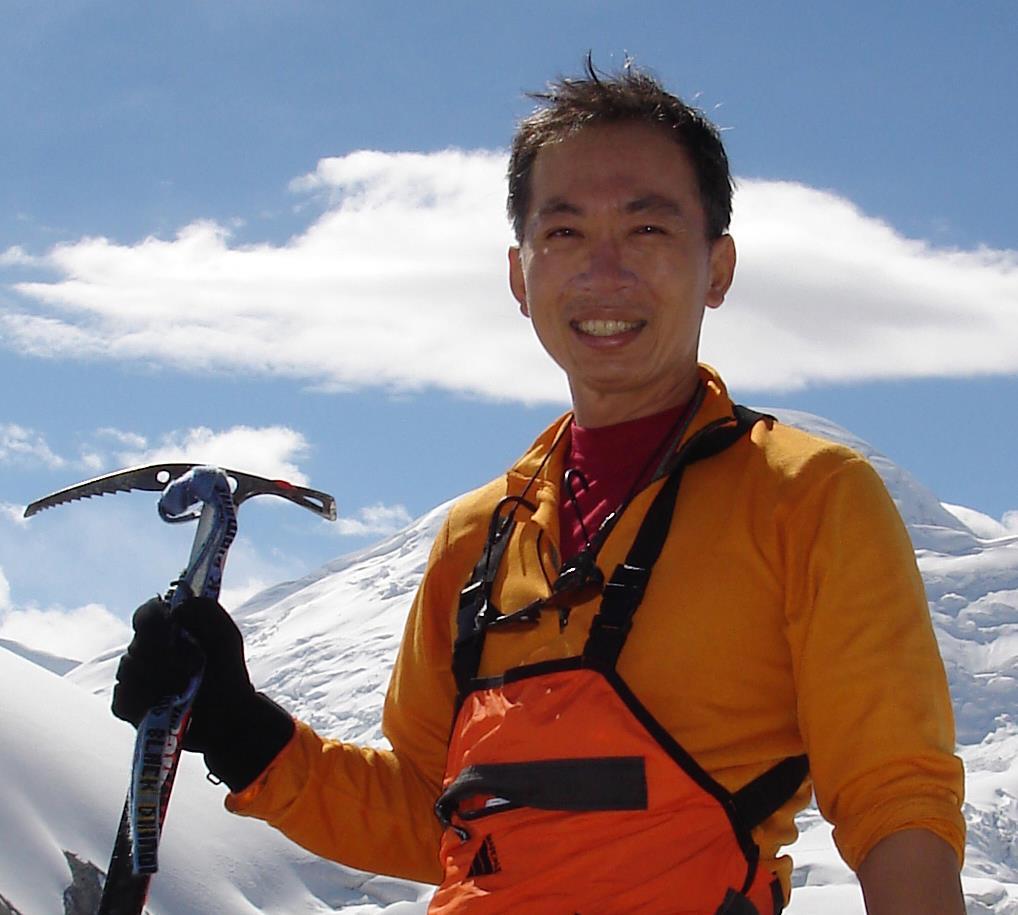
Partially disabled in both legs since 1998 from Guillain-Barré Syndrome, David’s passion for high places remains unquenched. Follow the adventures of Singapore’s prolific high-altitude mountaineer, leadership coach, author and motivational speaker.
About David Lim
Partially disabled in both legs since 1998 from Guillain-Barre Syndrome, David’s passion for high places remains unquenched. Keep track of the adventures of Singapore’s most prolific high-altitude mountaineer, leadership coach, author and motivational speaker through this site.
” Once I knew that life would not be the same again after my disabilities, I wanted to push the envelope – to see what a partially disabled climber can do, with minimal support. If you’re keen on following my adventures, where I don’t fancy having myself and all my gear dragged up the mountain by guides, Sherpas etc, stay engaged here, and thanks for visiting.”
David has delivered motivational keynotes and team improvement solutions in 34 countries and 83 cities. Find out more about his leadership and teambuilding programmes and solutions at:
David Lim
High-Altitude Mountaineer | Author | Motivational Speaker | Leadership Coach
ABOUT ME – WHY I CLIMB, WHAT I VALUE, WHAT I LIKE/DISLIKE
Hi,
Thanks for stopping by. I experienced a very late start to mountaineering at the age of 25; and in the past two decades have, in the Singapore context, ticked off a list of over 60 alpine ascents in almost every climbing medium, including big walls, local crags, waterfall ice, mixed alpine, extreme altitude and solo alpine expeditions. More than half of these climbs were achieved post 1998, when I became partially disabled from permanent nerve damage in both legs from Guillain-Barre Syndrome. A full list of alpine climbs are below.
Lorem ipsum dolor sit amet, consectetur adipiscing elit. Ut elit tellus, luctus nec ullamcorper mattis, pulvinar dapibus leo.
Why I Climb
I love finding my limits in a beautiful, if sometimes, harsh, environment; and often in the company of people I like and/or trust. Being constantly surprised by what I can or can;t achieve is a fascinating process. I started climbing after a reading a book, and it changed my life. Corny, yes, but true. It was the late Peter Boardman’s “The Shining Mountain”– a 1976 tale of how he and Joe Tasker climbed the massive, and fearsome west wall on Changabang in lightweight style. The honesty of the writing, the technical challenges (most of which I did not fully understand at the time), grabbed me immediately and sucked me into climbing. This was in later 1989 or so. Climbing’s made harder when you live in a city state like Singapore that’s at sea-level, and most of the usual social, career, and financial aspirations are antithetical to mountaineering. Good Singaporeans get a good education, job, and contribute to the economy. As part of the climbing community in the early 1990s, I existed on the lunatic fringe of society.
Climbing Philosophy and Values
If you are just interested in climbing as an achievement-based sport and/or a gadget head, you can skip this part. Ask a dozen climbers and you may get a dozen different replies.
I was influenced largely in my early years by my reading a lot of the classic books on mountaineering by Bonington, Harrer, Messner, Terray, Long, and others. Also by my bapism of fire – a 1990 five-week long winter climbing and skiing trip to the Alps; and a 1992 summer campaign where I bagged 12 ascents, including the Brenva Spur on Mt Blanc. I soon began to enjoy linking up the technical rock skills I practised in tropical Singapore, to the alpine zone and areas of mixed technical climbing – but nothing desperate; climbing to YDS 5.10c and leading WI4 and Alpine TD- at my prime. In the long run, this allowed me to ‘drop-down’ on the technical challenges in the mountains when I climbed higher. [ Q: How do you climb a 5.8 rock climb at altitude with a pack on your back? A: You learn to climb 5.10 in your local crag first]
I quickly realised why so many, especially other Singaporean mountaineers, struggled in the hills (not physically). Without a solid foundation of technical skills, they lacked the confidence and needed/wanted guides on almost every climb they made (and still do). By extensively relying on high altitude porters in the greater ranges like the Himalaya, they again absolved themselves from the work and skill to make decisions at altitude, and in general, lacked a sense of mountain routines, semi-conscious practice from lighting a fuel stove wth frozen fingers, and carrying a load all day, or pitching a tent in windy conditions.
Without the mountain sense gained from a long apprenticeship, they suffered from tunnel vision; never looking up to assess the weather, the route, timing (all important) and happy to yank up fixed ropes (set up by their guides) or be yanked up routes by Sherpas or guides. Have I used guides,fixed rope and sherpas – yes. But do I endeavour to do without them on most of my climbs – yes. They are there to serve a temporary purpose when one is new to the sport, or if the goal is massive and may required some external help. But eventually, the joy of climbing a peak on your own skill, experience, talents and efforts is immensely more rewarding. Yet, once hooked on this kind of assisted climbing, it’s like crack – it is very hard to give up. By paying for such help you maximise your chance of success on well-known peaks, and get others to do all the real mountaineering work – the leading, the rope fixing, the setting up of campsites, the decision-making, being on the sharp end of the rope… In a society where achievement is often valued much more highly than mastery, Singapore climbers can, in some ways, be forgiven for looking at mountaineering in the way that they do. Just check out the billion-dollar cramming-school industry in Singapore where students ‘ parents pay to help their kids get good grades, and who cares if they don’t enjoy the subjects. Getting an ‘A’ matters .
The saddest part in this stunted development process was, and still is a terrible lack of imagination in an often short, climbing ‘career’. Most would, and will go to New Zealand or India for a technical alpine-climbing course; followed by a trekking peak or two in Nepal (99% of the time, it’s Island or Mera Peak); after which it’s sometimes Aconcagua, by the easiest route. If they still have ambition, time and money, maybe Everest. And yet there is a lifetime’s worth of peaks, objectives, and routes elsewhere. But’s who’s to say that these dreams aren’t any better than anothers? Who am I to judge others?
But if climbing is to grow and mature, mountaineers must consider how they will and can push the sport – even within Singapore’s narrowly gifted context. But they don’t read any of the journals of record like the Alpine Journal or the American Alpine Journal to discover what significant climbs and routes are being done around the world – and some in very affordable, accessible areas.
And yet our public libraries have many books on climbing in the Alps, big walls and other interesting challenges. Instead, any reading done is often about the Seven Summits, written by neophytes who rarely climb a thing without being on a guided climb – and related stuff which was interesting in the 1980s but so ho-hum now. In short, knowing less of the world, makes them unimaginative in their quests. I have friends, and know some very nice people who have gone on this path. I respect anyone who wants to tackle this challenge. It’s about respecting the freedom of the hills. Perhaps, my biggest disappointment is NOT with the recreational mountaineer in Singapore (and even these are few and far between), but those that aspire to be more. I privately, and now publicly, wish there was just some more imagination on their part. If you want more out of climbing, you simply have to be more. Be more of a climber, and not a passenger.
I would prefer these pages to serve as wakeup call to those Singapore climbers aspiring to move beyond the usual recreational objectives. There are so many worthy and interesting climbing challenges if they only look beyond buying ‘packaged’ adventure, and become all-round independent mountaineers, rather than ‘mountain tourists’. Recently, all-Singaporean ascents have been made on routes like The Nose on El Capitan, and on Denali. These “all-Singaporean” climbs are superb in exemplifying exactly the kind of mountaineering spirit we need more of. More of such plans should be applauded and encouraged.
Climbing Style, Likes & Dislikes
I like climbing with people who have a good ‘system’ in the mountains, so when they get to a camp, they already know what needs to done, what needs to be squared away and so on without faffing around. When they climb, they think about what they are doing- all the time. I like climbing with people who have a good sense of humour, and are open to discussions about the objectives. Watching alpenglow, a hot meal after a summit, treading on a virgin summit – are all in my book of “super likes”. I like climbing in areas which present more than one objective and where there are route options. I like climbing in remote, quiet places; not the tail-end of a queue on a peak with 300 other climbers. Since 2005, I have enjoyed a bit of virgin peak climbing and have made seven ascents so far – not too many, but more than any SE Asian mountaineer ( refer to my point about imagination earlier). This is what, in my opinion, mountaineering should be about -self-sufficiency, a challenge, a researched zone – but still with some uncertainty of success.
I have permanent disabilities in both legs and my left hand since 1998 that prevents me from doing certain climbs or routes. But I still like climbing challenges which still make feel close to the mountain, rather than being a passenger; herded and assisted by a posse of guides and/or Sherpas. I’m also old enough to not give a damn of what others think. Oddly, on some rare occasions, I find myself actually outclimbing perfectly able-bodied climbers who have a greater level of assistance than myself. This is a nice vanity to enjoy while it lasts.
I dislike people with overly strong fixations about a peak or a route; who are ‘lazy’ on a mountain, and who don’t look out for their mates, and who don’t share the camp and climbing chores.
Off the mountain, I dislike bulls**t, and even in a climbing backwater like Singapore, you have quite a few people who have made a big deal of climbing a trophy peak in the easiest style rather than a lesser peak in the hardest style. Worse, you have people who say they summitted this or that peak in this or that style, when the evidence shows otherwise. To me, this is just rubbish, and is a poor example for upcoming, younger climbers to follow. A fellow climber related a story of a woman from Eastern Europe who became renown as the first woman of her nation to summit Everest. On another climb together, she struggled to operate a pressure camping stove – her story? The Sherpas did everything for them on Everest. Really. I have seen another woman (who eventually climbed Everest) being short-roped by her guide on easy (30-degree ice) slopes. A guide did everything for her including clipping and unclipping from the fixed line. Another climber, touted by some in the media as the ‘best’, has hardly done a single significant climb outside of a guided/supported team environment. “Yes” to freedom of the hills, but is this where mountaineering here and in the rest of the world should be going? You really wonder sometimes.
But as the great and late John Salathe said, ” Vy don’t ve chust climb?”. Indeed. Let’s go climbing.
David Lim
May 2013
Technical & High-Altitude Highlights
- Dhaulagiri VII Summit – 7,246m
- Cho Oyu – 8,201m Summited
- Everest – Attempted twice via SE Ridge
- Shishapangma – Summited via North Face
- Aconcagua – First all-Singapore ascent
- Ojos del Salado – World's 3rd solo via Argentina Route
- Seven ascents of virgin peaks
- "(and many more...)" — indicating the list isn't exhaustive
Personal Guiding Experience
- Guided in Nepal, Tibet, New Zealand, N. America
- Wilderness First Responder Certification
THE CLIMBS (IN CHRONOLOGICAL ORDER )
1990 – Mt Blanc Massif, France (winter)
numerous ice-climbs and skiing
1991 1994 Singapore Rock-climbing
Established several new routes including Char Kway Teow (5.9) and Fat Chance (5.6), Art of Noise (5.5)
1992 Swiss and French Alps
- Mt Blanc, 4800m, Brenva Spur, French D, III – FSA
- Zinalrothorn, 4122m, North Ridge, AD+, III FSA
- Brunegghorn, 3800m , PD, II, FSA
- Bishorn, 4100m, East Ridge, PD, II FSA
- Midi-Plan Traverse, AD, II
- Blumlisaplhorn, 3764m, PD+, FSA
- Weissfrau-Morgenhorn Traverse , 3500m, FSA
- Petit Verte, 3500m, PD., II (soloed twice, 1992 and 1996)
- L’Index, AD, III
- Chapelle de la Gliere, D, IV
- The Mammoth, 3500m, D, IV
- Miroir DArgentine, D, IV
- And two alpine rock routes (Pody Nave,Aig de Gloria)
1993 – Yosemite National Park USA, climbs include:
El Capitan, East Buttress, 5.10b, Yosemite, FSA
Fairview Dome, Regular Route, 5.9,Tuolumne, FSA
1993 Paldor Peak Expedition, Nepal
Ascents of:
Paldor Peak (5928m) by the Cleare/Howell Route, AD+
Pema Peak, PD (5300m) both FSAs
1994 California Sierras Yosemite National Park USA, climbs include:
Middle Cathedral, East Butt., 5.10c, A0, Yosemite, FSA, and several other alpine rock routes
1995 New Zealand Alps
Mt Cook, 3764m, Zurbriggen’s Ridge, TD- (55degree ice, 1000m) FSA
Mt Aylmer, 2800m, PD+
1995/1996/1997/1999/2000/ 2003/2009/2010 – Kinabalu Massif Led 6 trips primarily for multi-peak climbing. Ascents of:
Ugly Sisters c. 4000m, normal route, 5.6
Oyayubi, c. 3900m, 5.4
Kinabalu South, 3933m , South face, Borneo, 5.10a x 2
Alexandra Peak, 4000m, North Chimney, Borneo, 5.8
And multiple scrambles up Lows Peak ( 4095m )
1995- Singapore Nun-Kun Expedition, India
Nun-Kun, new route, 7135m (aborted at 4500m ; avalanche danger) Stok Kangri, 6153m, PD, summitted, lightweight style
1995 – Malaysia
Mt Ophir (1217m) single day hiking ascent and descent
1996 New Zealand Alps
Mt Tasman, 3500m, Syme Ridge and traverse of Silberhorn, TD-(50-degree, 800m ) FSA Attempt on Mt Dixon.
1996- Singapore Alps expedition,
including leads and ascents of
Grand Combin, Northwest Face, TD-, III (55degree, 2000ft ) FSA,
Petit Verte, 3500m, PD- (solo),
Piz Morteratsch and Piz Tschierva, FSAs
1996- Dhaulagiri VII, Northeast Face, 7246m, Nepal.
Summited. FSA, first 7000m peak to be climbed by Singapore team
1997 Korea and USA (winter)Water Ice Technical Climbs ( FSAs ) include-
- Spiral Staircase, WI4, Vail
- Lincoln’s Falls, WI4, Summit County
- Boulder Canyon climbs
- Coors Lite, solo ( WI2 ), Clear Creek, Golden
Soraksan climbs:
- Piryong Falls, WI3
- Towangsang, WI5
1997- Cho Oyu, 8201m, Northwest Ridge, Tibet
summitted. FSA. First 8000m peak climbed by Singapore team
1998 – Mt Everest, 8850m, Southeast Ridge, Nepal
(up to 7300m personally). 2 members summited. FSA.
2000 Argentina Andes
Cerro Vallecitos, 5500m, East Ridge, summitted. FSA
Cerro Aconcagua, 6962m, Polish Traverse, summitted FSA
2000 Singapore Tien Shan Expedition, Kazakstan
ascent of Kalrytau Peak, 5500m (to summit cornice)
attempt on Bayankol Peak 5791m + alpine training of 5 Singapore novice climbers
2000 Nepal Community Project, Nepal
Organised and led a community service mission to the Annapurna region, involving outdoor activities, agricultural and social work.
2001 Singapore Latin American Chile Expedition
ascent of Cerro Plomo 5430m (alpine style) FSA
Volcan Ojos del Salado 6893m (up to 6600m)
2001 – Everest North Ridge climb,
climbed to 7700m . Team reached 7800m, without use of bottled oxygen
2001 Turkey
Mount Ararat, 5165m south face guiding clients, summitted. FSA
2002 Nepal/ Tibet
- Mera Central Peak 6461m summitted
- Shishapangma , 8046m reached 7600m (oxygen free)
- Cho Oyu, 8201m reached 7950m (oxygen free)
2003 Mexico
Iztaccihuatl 5250m unsupported attempt. Reached Las Rodillas at 5100m
EL Pico de Orizaba, 5750m, Espinosa route summitted. FSA
2003 Russia/ Kabardino-Balkaria Republic
Elbrus, 5642m summitted via normal route
2004 Tanzania
Mount Kilimanjaro, 5895m Leader. Summitted via the Western Breach with an all-disabled team of mountaineers. Jan 2005
2004 Japan
Abortive winter attempt on Mount Fuji (3776m) via the Gotemba route in March
2005 Argentina
Solo expedition to climb (alpine style, solo) Ojos del Salado, worlds highest volcano at 6893m. Summitted Ojos del Salado ( Jan 20) and Cerro Medusa, 6125m (Jan 16). Worlds 3rd solo of Ojos (from the Argentine route) FSA
2005 Kazakhstan
Led team of four (total) climbers to the Central Tien Shan range on the Kazakhstan/Kyrgyzstan border to attempt virgin peaks. Jul 20 Aug 4 Summitted
- Temasek Peak (4374m) ( KZ/KYR )
- Singapura I Peak (4589m) ( KYR )
- Ong Teng Cheong Peak (4743m) ( KZ/KYR )
2006- Islamic Republic of Iran
Formed a climbing pair with Grant Rawlinson ( Singapore PR ) to make ascents in the Central Alborz mountains. 12 27 June. Summitted:
- Rostam Nesh (4500m) FSA
- Takhte-Rostam (4330m) FSA
- Damavand (Northeast Ridge FSA) 5671m
2007 Bolivia
1st Asian crossing on foot of the Salar de Uyuni, worlds largest salt desert five days of trekking across from Llica to Colchani approx 150km. Also First Singapore desert crossing on foot, unsupported. Fifth overall crossing on foot.
2009 Kyrgyzstan Tien Shan
Led the 3-man Spirit of Singapore Expedition which climbed 3 virgin peaks from the Mushketova Glacier. Aug 2-19. Summitted:
- Kongsberg Peak (4468m), PD-
- Resilience Peak (4447m), F, I
- Majulah Peak (5152m), PD+
2011 Tanzania
Mount Kilimanjaro, 5895m Leader. Summitted via Rongai route Aug 15th- 21st.
2012 Japan
Hiked up Mt Fuji 3776m via the Yoshida Route. Aug 3
2012 Qinghai Virgin Peaks
Sangay Ri (c.6000m) FA
Longyala Peak (6104m) to 6000m
2013 Mount Kinabalu 4095m
First mobility-impaired single-day ascent to the summit; from 1866m to 4095m in 8hours 25 mins. Aug 23
2015 - Mount Rinjani 3726m
2016 Caffe Bene Virgin Peaks expedition
Attempted traverse of two virgin 5000m peaks. Climbed Chulu Far East 6059m
Delivered motivational keynotes and team improvement solutions in 34 countries and 83 cities.
LANGUAGES
- English
- Malay
- Spanish
- French
- These days, David enjoys mountaineering challenges where he doesn’t feel like a passenger or a mountain tourist, and where he and his team can still feel challenged by the route and peak.
PEAKS CLIMBED BY ALTITUDE
5000m Peaks Climbed:
- 1993 Pema Peak
- 1993 Paldor Peak
- 2000 Cerro Vallecitos
- 2001 Cerro Plomo
- 2001 Ararat
- 2003 Iztaccihuatl to Las Rodillas
- 2003 El Pico de Orizaba
- 2003 Elbrus
- 2004, 2011 Kilimanjaro
- 2006 Damavand
- 2009 Majulah Peak
6000m Peaks Climbed:
- 1995 Stok Kangri
- 2000 Aconcagua
- 2002 Mera Peak
- 2005 Cerro Medusa
- 2005 Ojos Del Salado
- 2012 Sangay Ri (FA)
- 2012 Longyala Peak South Summit ( c.6000m)
7000m Peaks Climbed:
- 1996 Dhaulagiri VII/ Putha Hiunchuli
8000m Peaks Climbed:
- 1997 Cho Oyu
- 1998 Everest South side ( to 7400m)
- 2001 Everest North Ridge (to 7800m sans supplementary oxygen)
- 2002 Shishapangma (to 7600m, sans supplementary oxygen)
- 2002 Cho Oyu (to 7950m sans supplementary oxygen)