NEWS
Pork Pies and Adventuring: The Role of Ethics and Style in the Game.
by David Lim( first published in May 2005 in a Singapore sports magazine)
In 1968, Donald Crowhurst was part of a flotilla of yachts competing in a round the world race. After crossing the Atlantic from the start of the race from Britain, he began falsifying his logbook and radio transmissions to give the impression that he was doing well in the race. When his plan began to unravel, he could not bear it and threw himself overboard, never to been seen again. Only his notes and papers revealed the true nature of his ‘achievement’. In the 1990s, ace Slovenian climber Tomo Cesen claimed to have solo-climbed the much attempted and stupendously difficult 2000m high south face of the 8500m-high Lhotse.. Feted for a while, discrepancies arose from studies of his photographs and other evidence. He is now discredited.
In 1992, a Singaporean expedition made the news by claiming to have summitted Mera Peak, a straightforward 6000m peak in Nepal. The reality was that the team never made it to the top. The expedition leader later admitted in private that the media “ had to be told something”. A decade later another Singapore team covered in the news claimed to have summitted Shishapangma, an 8046m peak. The team enjoyed accolades and full page advertisements by their sponsors for “summitting” Shishapangma. Then their claim was challenged, with focus on the fact that they had climbed a lower, subsidiary point along the 2km-long summit ridge known as Shishapangma Central, and that they did not climb to the top*, as claimed in the press. In their defense, the team submitted a ‘certificate’ by the Chinese Mountaineering Association that deemed that any team that climbed Shishapangma Central was considered to have summitted the peak. This, to some, flew in face of common wisdom – if one has not climbed to the top, then no certificate in the world, surely, can assist you to do so after the fact.
There are some written ‘rules’ in existence in the adventure-sports world, such as the English Channel swimming association’s rules about the actual amount of assistance a swimmer is allowed to receive In climbing, there are few written rules, but many unwritten rules that dictate how an ascent be categorised (with more kudoes given to ascents made in a more challenging or elegant style). Tomo Cesen, to use London Cockney parlance, told a ‘pork pie’ (a lie), and he got caught. More complex issues surround achievements based on doing something in a particular style.
But why should style matter? Ask ten serious proponents of any established adventure sport and you may get 10 different answers bar one thread of argument: in order to distinguish milestones in a sport, you need some yardstick to sort them out according to their quality of achievement. By doing so, you can sort out the best achievements and those who are pushing the sport’s limits in terms of endeavour and skill. So climbing a challenging peak normally climbed in traditional expedition style with minimal gear and support counts for more than a standard ascent. Harder style, more skill, more kudoes.
However, if you want the kudoes but do not pay heed to style issues, such claims only serves to demean the achievement of those dedicated to quality results – very much like how people who have earned their doctorates feel about people who literally ‘ buy’ their PhDs from degree mills with minimal academic study and challenge. And we have our fair share of those people here in Singapore as well.
As more Singaporeans head into adventure sports with little interest or knowledge of their communities or the history of their sport, one can only wonder how sporting achievements will be tempered with the importance of ethics in their respective niches. John Barnes, Australian sociologist, and author of the book, A Pack of Lies, reflects how society expects sportsmen and women to somehow aspire to higher level of existence – that they are above the dross of commercialism and cheating. But with greater and greater emphasis on sponsorship, money, spectator interests, higher expectations, society is disappointed when a sportsperson is found wanting, or has been economical with the truth.
We all have our egos to stroke at one time or another, and if we can fib about not stepping on that that steel bolt to complete the 2nd pitch of rock-climbing route #23 on a Sunday afternoon climb on the local crags, what else might we capable of? Ultimately, the integrity of adventure sports achievements, done out of the glare of TV cameras, depends on the ethics of their practitioners. There is often too great a temptation to say ‘ we did it’ especially after suffering for days or weeks for our goal. Yet, it is the stronger soul who says “ we nearly made it, but for….”
The beauty of sports such as mountaineering is that embraces all – from those who find challenge in a blank 20-metre piece of vertical granite, to those who like to suck thin air over 7000 metres. It also respects and embraces practitioners who delight in easy ascents with professional help, and those who push their limits alone on extreme climbs. It is the climbing community that expects that its practitioners be completely transparent about the style in which a challenge is achieved, and this expectation is sometimes beyond the common public’s understanding.
A simple guide to keeping to the ethics of any game of unwritten rules might be thus:
1) ensure your claim or achievement is beyond reproach or doubt
2) be absolutely transparent about how you achieved it
3) respect international practices/definitions in your field of endeavour
4) you are responsible for your press releases
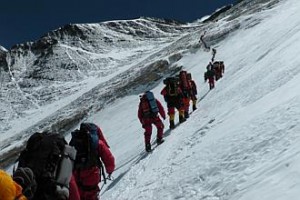
The game of climbing all the 14 highest peaks (the 8000m peaks) in the world is a tough, risky and expensive venture, often taking years. It rarely involves a high level of climbing skill, and a participant can have all manner of external help in the form of professional guides’ assistance, local high –altitude porters (such as the famous Sherpas in Nepal), maybe even using bottled oxygen on some, or all the peaks to be attempted. These days the game is perhaps less about the enjoyment or the quality of climbing experience; but more of being able to say that you did it. The current game of climbing the 8850m-high Mount Everest sees fewer dedicated mountaineers aspiring to climb it, and more dilettantes or list-tickers attempting it for the privilege of having said they did it. The mountaineering world embraces all of them, although it does raise eyebrows at some of the stupendous incompetence displayed by some.
However, one rule remains is that the summits have to be reached. Exceptions include certain sacred summits where for local or religious deference, one might stop some metres from the actual top. But unless there is scope for the lower 8750m Everest South Summit being recognised universally as a separate peak in itself (which it is not), you can only say you’ve climbed a peak like Mount Everest when you have… uh… climbed it.
Reinhold Messner, arguably the greatest living mountaineer, and the first to complete climbing all the 14 8000m peaks, said, “All the 8,000ers have one, nothing else and that is a main summit. ” Erhard Loretan, the Swiss veteran of the 14 8000m peaks said, ” If people want to play, in my opinion, the climber must reach the highest point ”.
And no certificate can say otherwise.
David Lim has led and made ascents of over 60 alpine peaks and expeditions, including five to 8000-metre peaks; and has held leadership positions in the Singapore Mountaineering Federation and the Mountaineering Society of Singapore since 1991. For more News and Views and opinion articles by him, go to the News and Views section.
[ Editors 2012 note]
*Shishapangma Central at 8027m was climbed. This subsidiary bump/summit on a long summit ridge is the point where 90% of climbers stop. The actual top/summit of Shishapangma is at 8046m, and attained only by a long and tricky knife-edge traverse that is pretty exposed with huge dropoffs on either side. The Chinese Mountaineering Association gives ‘certificates’ to climbers who have climbed to the Main summit as well as to the Central summit – very much like those awarded to trekkers who stop at the crater rim of Stella Point while climbing Mt Kilimanjaro, as well as those who tag the higher Uhuru Peak (the main summit), about an hour’s traverse away on the crater rim.
Since this feature was published, other well-known climbers have admitted to making mistakes both out of ego, and exhaustion by claiming a ‘summit’ when they had not got to the actual top. Christian Stangl who, in 2010, claimed to have climbed K2, made a dramatic media U-turn shortly afterwatds, and admitted that he had made up the summit success. Ed Viesturs, the first American to climb all the 14 8000ers, made an ascent of Shishapangma in 1993 to the Central summit (like the Singapore team in 2002), returned in 2001 to ‘make right’ the shortcoming, and bagged the true summit with Viekka Gustafsson.