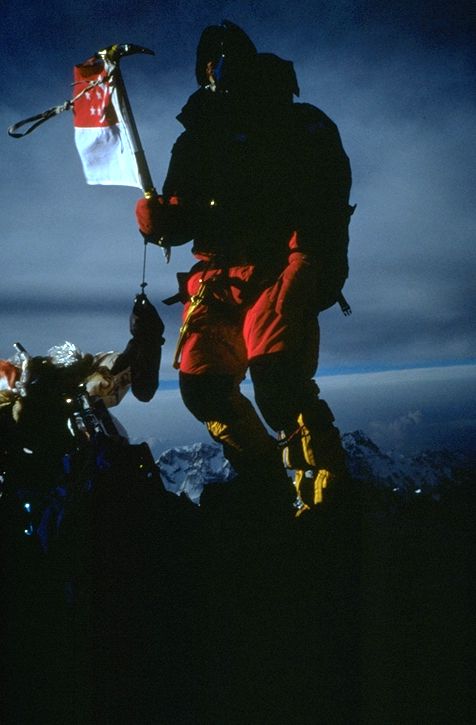
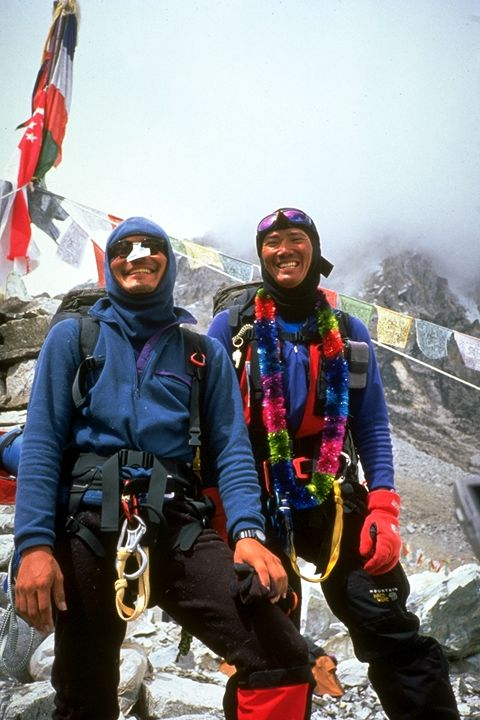
Camp 2, 6,500m, Friday, May 15th 1998
Snow on the Mountain
Dr. Shani Tan
It has been a cold, damp and cloudy day here at Everest Base Camp. It started to
snow gently at dinner time last night and remained fog-bound all night both here and
in the Western Cwm. At 0400h this morning, winds became moderately gusty and
started to snow steadily until 0700h. At the 0600h radio call, the guys at Camp 2 informed us that they will not be moving out to Camp 3. It was snowing there but not too heavily and the wind was not high but visibility was poor. That being the case, Mok and Leong and three Sherpas in EBC were kept from moving up as that would only tax the logistics at C2.
Unfortunately, neither of the weather reports that we have been receiving (from the UK and Singapore) give us any idea of precipitation, which is governed more by local air current convection factors. Tomorrow, the two remaining climbers and
Sherpas will move up to C2.
Weather permitting, five climbers will move up to C3 — Edwin will remain at C2 as support. As we transmit this report to you, we will also be downloading another weather report. We hope that the five-day forecast will be favourable for a summit push. On the brighter side, two climbers from another expedition returning from C3 have told us that our tents there are intact, although covered with snow.
Camp 3, 7,200m, Friday, May 1st 1998
How we made it to Camp 3
Dr. Shanni Tan
Camp 3 climbing report :
Swee Chiow, Edwin and Leong left C2(Camp 2) at 0930h yesterday morning under perfect climbing conditions for C3(Camp 3). They were accompanied by our climbing Sherpas who helped to ferry more loads up to C3. There were also numerous climbers from other expeditions making their way to C3. The Lhotse Face was in very good condition with firm snow and big “buckets” kicked into the hard blue ice by climbers preceeding them. Swee and company made very good time and arrived in C3 by 1520h. Camp 3 is strung out over several hundred vertical meters on the Lhotse wall. It is roughly divided in to an upper and an lower camp. We have three 3-man Mountain Hardware tents in the lower part of C3 at approximately 7200m. The position of the tents even though guyed down with heavy duty rope is quite precarious, as they are resting on hard snow and ice. To carry out any activity outside the tent ( eg. going to toilet ), one has to “clip in” to the ropes to prevent a kilometer long fall down a sheer face of ice. They spent a very cold night in C3 ( it was very cold even in perfect windless conditions ) and were comfortable without the use of supplementary oxygen.
Camp 3 team returns to Base Camp :
We had a very hot morning with bright sunshine and very little wind both at BC (Base Camp) and in the Westerm Cwm, clouding over by 1430h with rain and hail by 1630h. At the 0800h radio call, Swee, Ed and Leong were within 10 min of C2 having left C3 at 0630h this morning. The others; David, Justin, Mok, Roz and Robert were just starting out from C2 for C3 accompanied by Sherpa support. The C3 people rested in C2 while Sonam and Urke made rice porridge for breakfast. By 1200h, the trio from C3 were in the ice fall enroute to BC but the other 5 are still on the fixed ropes leading up to C3. Swee and company made very good time and arrive in BC by 1320h where they are now resting, rehydrating and reading emails with great gusto. ( Email was the great incentive to come down early it seems). At the 1600h radio call, Mok, Roz and Rob had just gotten into C3 with Justin and David reported 5 and 20 minutes away respectively.We will have a further call at 1800h during which Mok will give a medical update on Justin and Roz. It is yet unknown if they will sleep on supplementary oxygen tonight.
Camp 3, 7,200m, Saturday, May 2nd 1998
Strong Winds Prevail
Dr. Shani Tan
Second Team hampered by winds at Camp 3
At EBC, we had a fine hot sunny morning, clouds rolling in by lunchtime and it began to hail then sleet and snow. And by 1600h we have two inches of snow. However up on the Lhotse face, David, Justin, Mok, Roz and Rob were buffeted by winds from the early hours of the morning. Team 2 made for C3 yesterday starting at 0800h in the morning. Rob and Roz arrived at about 1430h with David, Mok and Justin arriving two hours later. David was very tired to start with having had a bad night the night before and Justin was tired out by his cough. All had a sleepness night in C3 without supplementary oxygen. This morning they left C3 for EBC in windy conditions with blowing spindrift swirling into the vestibule preventing them from brewing up before making the descent. Leaving at 0730h, and “running on empty “ Rob and Roz arrived at C2 at 0900h with David, Mok and Justin arriving 30 min to an hour later. They had some breakfast and drinks. Rob and Roz left C2 for EBC at 1030h arriving just after 1500h. Mok, David and Justin being very tired opted to stay in C2 for the night. The guys in C2 will descend to EBC tomorrow. The medical plan is for Justin and Roz to descend further down to Pheriche (4,240m, home of the Himalayan Rescue Association) for a few days so that their cough may improve with the appropriate medication. This is because infections of any sort (including chest infections), cuts and wounds do not heal quickly in the rarified atmosphere of EBC, where oxygen level is a third that of sea level.
Waiting game begins
After this, the wait will be for C4 to be established and for the right weather window of about four days. A weather window usually occurs just before the arrival of the south west monsoon when the winds stop and the weather is calm. The first assent of Everest was made on May 29. We will be keeping a close eye on the arrival of the monsoon, still reported to be in the Indian Ocean. Closer to summit day, we will be getting more frequent weather forecasts from our sources.
Route through to South Col
A large number of Sherpas (41 including ours) reached South Col yesterday to stock up for C4. However due to the windy conditions this morning, our Sherpas made it only to C3 before turning back.
Camp 3, 7,200m, Sunday, May 3rd 1998
Some respite for tired climbers Dr. Shani Tan
All climbers back in Base Camp
We had a hot, sunny morning giving way to an overcast afternoon with rain turning to snow by 1530h replacing the four inches of fresh snow we had yesterday afternoon which had all but melted in the heat of the morning sun. The hot sun this morning no doubt made the trip down from Camp 2 more energy sapping for the climbers. David, Justin and Mok left C2 this morning at about 0800h and made their way back to BC, eventually reaching BC at about 1310h all arriving within 20min of each other. They were very tired, dehydrated and sunburnt. All are now resting after some food and drink. As planned, tomorrow Justin and Roz will descend to Pheriche for a well deserved rest. Hopefully their coughs will get better in the warmer and richer oxygen of Pheriche, which is a good 1,000m lower than BC. They will be away from EBC for approximately five days. We will maintain daily radio contact with them during this period.
Yale / MIT Team arrive in Base Camp :
The Yale/MIT research group arrived in BC today preceeded by a big yak train. They are attached to the Eric Simonsen/Wally Berg GPS team and will be here in EBC carrying out scientific experiments for the next two weeks. We hope to bring you an update on that soon.
Base Camp, 5,200m, Monday, May 4th 1998
Today’s Special: “mee suah” Soup Dr. Shani Tan
Rest and Recuperation time :
Everyone is in BC(Base Camp) except for Justin and Roz who left for Periche this morning shortly after breakfast. 6 Sherpas came down to BC this morning, leaving the remaining 6 to continue ferrying loads between C2(Camp 2) and C4(Camp 4). Most people spent the day resting up, especially those who had come down from C2 yesterday. Laundry drying in the hot sun, journals being updated, tent platforms rebuilt ( as the days grow warmer and longer, the glacier beneath us melts at an increasing rate and we find our tent sites breaking up at an alarming rate ). Johann made a trip down to Kala Pattar today as he missed out on it on our walk in. Unfortunately, the overcast conditions with intermmitent rain and sleet made the trip less pleasant and presented poor photo opportunities.
Mok’s Base Camp Restaurant reopens !
Mok, our inteprid Base Camp gourmet cooked chinese “mee suah” soup and stir fried vegetables in oyster sauce for lunch. Our Base Camp kitchen staff and some Sherpas observed with great interest but declined to sample the results. Our team, however consumed the dishes with great gusto. It is rumoured that dinner will be another Mok special tonight !
Crazy weather in BC :
It was hot, bright and sunny in the morning with scorching sun but clouds billowed up from the valley and gave rise to intermittent showers and partially overcast sky from 1200h. It is very hot within the tents when the sun is full on the tent whilst outdoors the sun burns the skin even though the air temperature is down a about 10C. The entire Westerm Cwm was covered with thick cloud from midmorning and from Kala Pattar, there was no view of the summit which was also covered with cloud.
Base Camp, 5,200m, Tuesday, May 5th 1998
Rest and Plan Dr. Shani Tan
Resting up and planning :
Yet another rest day today. All team members except Justin and Roz ( who are in Periche) are at EBC. Justin and Roz passed word to an Iranian expedition member who met them in Periche that they are OK. We are in actual fact NOT in daily radio comms with Justin and Roz. David met up with Henry Todd of Himalayan Guides today to discuss summit plans. It appears that the portion of the summit route from South Summit to the actual summit will be fixed by Wally Berg’s team but as yet there is no agreement between expedition on “fixing” the remaining part of the route from C4 up to the South Summit. There will be further discussions in the next few days with respect to this issue. David and Bruce have also been discussing the logistics and possible pairing up of Sherpa and climbers this morning. The summit teams have yet to be chosen. The proposed summit attempt date has yet to be fixed but we plan to have people ready to move up the Mountain again by perhaps the 10th if the weather is suitable.
More goodies arrive !
We have recieved the replacement cable and printer ( specially modified for our purposes ) from HP, tasty snacks and chocolates from Muei Hoon and other very welcome goodies. Many thanks also to Charlie who bought a big ( 500g ) bottle of Marmite for us
Base Camp, 5,200m, Tuesday, May 6th 1998
The Wait David Lim
Basecamp Wait:
The team is currently resting and waiting for a suitable summit push, most likely to take place from the 8th May with a possible summit push just after the full moon on the 12th May. Today, a meeting with Bruce Niven, David Lim and Chief Sherpa (or sirdar) MB Tamang and assistant sirdar Kunga Sherpa was held. The meeting was to determine supplies currently at the two high camps, Camp 3 and Camp 4; communications protocol during the summit push and oxygen usage sequence on summit day and other primary concerns. Of interest will be the Bracknell weather forecast due out on the 7th and will be good for four to five days. The summit party has yet to be named. Other teams seem to plan summit pushes around the same period with likely summit dates as follows (unconfirmed): Wally Berg, 13th May, Himalayan Kingdoms, 10th May, Everest Challenge, 11th May. Henry Todd’s first group of three Britons is likely to go on the 11/12th with the second group off in a few days later. Aussie Alan Silva is likely ot be climbing ‘alone’ and not in a group, although overall support will be available for the whole group of smaller sub-parties. Three Swiss guides including the famous Andres George will be heading for Lhotse and Basque soloist Ignaqui is likely to making his third attempt this season on the rarely climbed 8,000 metre peak.
Trekker Death:
No details as yet but it has been reported that a Japanese trekker died two nights ago in his tent at a campsite in Gorak Shep, a few hours from Everest Base Camp and the last overnight stop for visitors to base camp. Initial reactions suggest he had high altitude health problems but chose not to descend.
Incompetence on the Mountain:
A peculiar incident happened last week when the Camp 3 party of Swee Chiow, Chee Mun and Edwin were en route to C3. At the beginning of the fixed ropes, there is a fixed line which traverses right and upwards. To the right is a red line for descending parties to abseil past ascending parties. At this rope were three English-speaking climbers who seemed reluctant to descend. Upon passing them, it was realised that the reason why they were at that position for such a longtime was because none of them were sure how to abseil in the first place (!). Eventually, their guide or more experienced team-member descended and helped them with this most basic of climbing skills. It is the view of the team that such people have no place on this mountain. In a similar incident last year on Cho Oyu, a well-equipped client of a very well-known commercial mountain-guiding firm was incapable to clear a 60 metre ice section; causing a potentially hazardous bottleneck of climbers.
Media indifference to criticism:
About two weeks ago, I mentioned the media’s general abuse of the word ‘conquer’ in the realm of mountaineering. Despite attempts to educate sub-editors, journalists etc, the term is still abused, much to the chagrin of climbers. Several days ago a local newspaper and its Web site version lifted my quote about how mountains are never conquered but deftly omitted my criticism of the media as a whole about their overuse and abuse of the term ‘conquer’, How amusing.
Base Camp, 5,200m, Thursday, May 7th 1998
The Waiting Game continues Shani Tan
The weather report we have received from Bracknell in UK forecasts very high winds near the summit for the days of 8th, 9th and 10th. To attempt to summit then would be suicidal. We are of course then waiting for another forecast for the days following those windy ones, ie for May 11th to 15th. We hope that this would be favourable and the summit team(s) — yet to be announced—will be mobilised accordingly. However, all is not idleness at EBC, we have been preparing high-altitude drink rations for the Sherpas, identifying a helipad site in event of emergencies, liasing with other expeditions with regard to summit attempts. The good news is that the monsoon (the arrival of which will mean the end of the climbing season) is well in the Indian Ocean, far away from us.
Interview with the Yale/MIT team
A 13 strong Yale/NASA/MIT team arrived in EBC a few days ago led by trek leader Scott Hamilton. The team consists of three doctors and 10 scientists from MIT who will be testing “advanced medical” and “telemedicine” devices. Their expedition, called the “Everest Extreme Environments” or “E3”, hope to test out various high tech medical monitoring devices in the extreme environment of Mount Everest. They are collaborating with Wally Berg’s GPS team of climbers who will wear some of these devices on their bodies as they attempt to reach the summit. These deives although sophisticated medical monitors are specially designed to be small and light-weight. This project not only has implications for military and space research, but also important to the man in the street. A patient with telemetry devices attached to him may be monitored at home and on the move, increasing the knowledge of some medical problems and also allowing the medical practitioner to give more comprehensive care to his patient. These telemetry or remote monitoring devices may also allow specialist advice for patients in rural areas where no such care is physically available. The E3 team will also be transmitting live video reports daily to Yale and also will be video conferencing with a medical conference in the US on the subject of telemedicine some time later next week. All this is made possible with very high speed data links and sophisticated electronics. For more information on telemedicine, visit the AT&T Website.
Base Camp, 5,400m, Friday, May 8th 1998
Waiting on “mountain time” Shani Tan It was hot and sunny with moderate winds at Base Camp but very high winds could be seen blowing snow off Lhotse and Nuptse. In fact the winds up high near the 7,500m
- 8,000m level appeared to be blowing in a vortex. All attempts by Sherpas from
some expeditions today to reach South Col have been turned back. Everyone is back in EBC, including Sherpas. Justin and Roz came back today from Pheriche, both of them with some improvement in their coughs. Contrary to common belief, acclimatisation achieved by climbers is retained for a good two weeks so there is no danger of losing it by a period of rest and recuperation lower down in Pheriche. The rest of us put in some manual labour to shift rocks and gravel to repair tents sites belonging to Swee, Mok, Edwin and Leong. (very good exercise at 5,300m ). We are waiting yet again… the weather report from Bracknell correlates well with our MSS report—high winds extending all the way to May 14th. With the jet stream hovering over Everest’s summit—winds reaching 80 knots which is approx 150kph. All climbers from all expeditions at EBC are waiting anxiously for the weather to take a turn for the better. But as a veteran, who is no stranger to Everest, said—we are here on “mountain time”—to expect to come and climb Everest without waiting out the weather is unrealistic. Incorrect reports We have heard reports that RCS has reported that our climbers have been to Camp 4
- that is incorrect. Most expeditions do not spend time acclimatising at C4. It is a drain on resources and puts climbers at unnecessary risk. Furthermore, the human body does not acclimatise well beyond C3. The usual practice is for the Sherpa teams to carry loads up to and stock up C4 in preparation for the summit push.
Base Camp, 5,400m, Saturday, May 9th 1998
Taking on the “Jetstreams” David Lim, Expedition Leader
THE JETSTREAM ARRIVES:
The jetstream, the winds which occupy the higher levels of our atmosphere has arrived. The band of these super-fast winds is currently over the Everest zone and is causing winds at the summit level to hit 160km/h. They are expected to persist at least up to the 14th. The bottom line is that no one will be making a summit attempt for another week. It’s a waiting game. Some of the other teams’ members have gone down to Pangboche for the warmer and thicker air for a few days. The team spends its time reading, resting, shoring up tent platforms and such camp chores. The heat of the warmer months is causing basecamp – which is situated on a glacier – to melt out. Rocks prevent the bare ice from being exposed to the sun’s power and delays the inevitable.
LANDING ZONE PREPARED:
This morning, base camp manager Bruce Niven and our sherpas prepared a landing zone for helicopters. The zone, previously recced by Bruce, was probably an old site which, through the shifting ice of the glacier, needed work. The LZ will be useful in any possible emergency where a helicopter evacuation is required. Bruce has also prepared resources forms for team leaders to complete. This will centralise information regarding possible summit dates, location of important resources like oxygen, radio frequencies at various camps and the names and locations of team doctors.
THE IRANIANS:
One of the many teams here are the Iranians, led by Mr Rafsanjani. They are 17 strong and have permits for both Mt Everest and Lhotse, Everest’s neighbouring 8000metre peak. This is Iran’s second attempt at Everest since it’s first successful climb, done as a joint Iran-Japan expedition in 1978. Their previous training peaks in the past few years have included peaks in Iran itself and much larger Himalayan peaks like Rakaposhi ( Pakistan, 7700+metres ) and Gasherbrum II ( Pakistan, 8000+metres ). Unlike the Singapore team, the national Iranian team have been fully funded by their government, an advantage often possessed by teams from countries with a ready- established mountaineering tradition. We wish them good fortune and safe climbing.
WELL-WISHERS:
Once again, many thanks to our well-wishers from The USA, Brazil Singapore, Malaysia and from many other far flung corners of the world, many of whom we will never meet but are brought closer to us by the power of the Internet.
Base Camp, 5,400m, Monday, May 11th 1998
Bad weather up on Base Camp Dr. Shani Ta
High Winds threaten BC
We spent the night listening to the roar of the jet stream over the mountain and woke to see clouds streaming over the summits at speeds well in excess of 150kph. Our Sirdar, with many Everest expeditions under his belt came after breakfast to warn us that the winds may descend all the way to BC. With that we checked and tightened all our guy lines. Indeed at one point it appeared that his prediction might come true as the vortices of wind and snow were seen on the Ice Fall at an altitude less than 500m above BC. By 1200h howvever, the winds had subsided somewhat and were replaced by a steady snowfall. The visibility now is about 200m and it is still snowing hard. We have just received another weather report from Bracknell which does not give us any reason to rejoice; the bad weather will continue at least for the next two days, lifting slightly for another two before deteriorating to even worse conditions by the end of the coming week.
Winds wreak havoc at CAMP 2
Verbal reports from our staff at C2 say that many tents from all the expeditions have been at least damaged if not completely blown away by the high winds. Our two kitchen crew at C2 managed to collapse our tents at C2 and weigh them down with rocks to prevent them from being blown away. The situation at C3 remains uncertain for all of us at BC until someone can actually assess them in person. It has been a cruel blow for those expeditions whose tents have been blown away, together with vital equipment contained within as these may be irreplacable. We can only hope that our equipment at C3 is still intact, but that can only be ascertained when it is safe to go back up the mountain. Trekkers arrive in the snow Two trekkers, Muei Hoon and Maurice arrived safely in BC today at 1600h.They will be spending at least a night with us.
Base Camp, 5,400m, Tuesday, May 12th 1998
Wind wind go away Justin Lean
Bad Weather Hits High On The Mountain :
The weather was bad yesterday 11th May. Apparently the night before, winds started gusting to 180km/h at the summit of Everest. This is in line with the weather reports we have been getting, stating that the jetstream will sit just at the summit of the mountain for the next few days. High winds also affected the mountain lower down. Winds tore at camp 2 (6500m) on the night of the 10th. Luckily, we have two Sherpa cooks, Sonam and Urke stationed at camp 2. They had the foresight to collaspe all our tents at camp 2 before serious damage was done. They then sought refuge in the tent belonging to the cook of another expedition, the latter being good friends with them. No one slept a wink due to the violence of the winds at camp 2.
Camp 2 Devastation :
Other expeditions were less lucky. Having no personnel at camp 2, their tents were left to the mercy of the winds. Reports have it that some tents have been destroyed and others have been blown away. This does not bode well for these expeditions as crucial climbing equipment were stored in the tents. If these have been lost, it could mean the end of the trip for them. It is now up to the expeditions to send personnel up to ascertain the extent of the damage. Today (12th May), no one was sent up except some Sherpas from Henry Todd’s group, the rationale being that it would be better to allow any fresh snow that has fallen during the storm to settle or avalanche off the mountains first. The Sherpas from Henry’s group will be roped up and extra cautious.
What about Camp 3?
Not much is known about the status of camp 3 (7200m). Our Sherpas at camp 2 say that visibility is not good enough to get a visual report on camp 3. It is hoped that snows from previous snowfalls will weigh the tents down so that they don’t get blown away.
Jetstream Continues :
Winds continued to blow on 11th May. Clouds could be seen forming fantastic patterns as the winds hit the ramparts of Everest and Nuptse. The howling of the wind could be heard at base camp – it was as if base camp was next to the busiest airport in the world.
Waiting It Out :
Though winds have been high on the mountain, things have been quite calm at BC. It has been totally perfect today (12th May). To keep ourselves occupied, climbers have been busy reading, performing minor repairs on personal kit and getting to know members of other expeditions better.
Landing Zone Constructed :
In case of an emergency, Sherpas of our team constructed a heli-landing pad on the Khumbu Glacier under the watchful eye of Bruce our Base Camp Commander. This landing pad is positioned just due South of the tents at Base Camp. In the event of an emergency, our base camp team will head to the helipad with a bag of juniper leaves and kerosene to create a smudge fire. Bright cloth and strobe lights will also be used to guide the incoming pilot. Two way communications will be established to co-ordinate the landing. Hopefully. things will not have to turn out this way. Our landing pad will be open to use for other expeditions.
Intentions for 13th May 1998 :
Climbers will be headed for higher ground to maintain their acclimatisation. Rozani, Swee Chiow and Justin will be headed up the icefall to spend a night at Camp 2 (6500m). Hopefully, they will also be able to assess the damage done by the recent windstorm at Camp 2. The rest will be taking a hike to Pumori Base Camp and return on the same day. Pumori is a beautiful 7000m+ mountain near Everest.
Camp 2, 6,700m, Wednesday, May 13th 1998
Back to the Mountain Dr. Shani Tan
Going back to the Mountain :
Justin, Roz and Swee left for Camp 2 this morning at 0600h, with the latter two arriving at about 1300h and Justin at 1400hr. Our tents at C2 are intact with all our gear in place and we have reports that our tents at Camp 3 are still intact.They have been instructed to stay in C2 tomorrow instead of returning as originally planned as the rest of the climbers intend to go up to join them tomorrow. The remaining climbers took a short four-hour walk to a ridge above Pumori BC from where they had excellent views of the South Col and the summit ridge of Everest. This has potential as a likely spot for good comms during the summit push.
Video conference with Yale Medical School :
Shani, the Expedition Doctor took part in a live video conference with Yale Medical School where topics of discussion included altitude sickness amongst tam members, sherpa crew and other mountain medicine issues. This was part of the daily live conferences that the Yale/MIT team carry out.
Trekkers leave us for warmer climes : Muei Hoon and Maurice left us today for Lobuche – we want to thank them again for bringing us replacement Hewlett Packard parts and also many edible goodies.
More of Mok !
Mok again demonstrated his culinary skills by making an excellent Nasi Goreng Ikan Bilis for us at lunch time.
Camp 2, 6,700m, Thursday, May 14th 1998
More heading up to Camp 2 Dr. Shani Tan
More climbers move up to C2 : Last night was relatively cold and clear. At 0530 this morning, most of us woke up to see David, Edwin and Robert off to Camp 2. They were accompanied by 9 Sherpas carrying supplies to restock C2. They will join Justin, Swee and Roz who are already there and help make repairs to the tent poles that were broken in the recent wind storm. Tomorrow, Mok and Leong and the remaining Sherpas will move up to C2. Base Camp is otherwise very quiet as climbers are packing in anticipation of a weather window appearing in the next few days. Wally Berg’s team have also been wired up with bio & geo packs and will move up the mountain tomorrow.
Camp 2, 6,500m, Saturday, May 16th 1998
Nature takes charge Dr. Shani Tan
All was calm here at Everest Base Camp. In the early hours of the morning, however, the dining tent at Camp 2 was blown down by strong winds. At 0500h, a gigantic avalanche slid down the LhoLa and the resultant cloud of snow and debris dusted the tents in C2 and the Icefall. Fortunately no one was injured by this spectacular event. Following yesterday’s heavy snowfall,there was significant avalanche risk. After much discussion between the expedition leaders already at C2, it was decided that everyone should wait another 24 hours for the snow to consolidate before moving up to C3. The hot sunshine today and freezing conditions tonight will help to consolidate the snow through a thaw/freeze cycle. One small team of Iranians made an attempt to go to C3. We have no report on their progress. Some of our Sherpas made their way carefully to C3 to dig out our tents and remove snow from the interior of the tents. They are now back in C2. They reported hazardous conditions on the Lhotse Wall. Our team at C2 will attempt for C3 tomorrow while Mok and Leong and the remaining Sherpas will move up to C2 from Base Camp.
Favourable weather but… The Bracknell weather report from UK just in at 1245h said that winds over the summit for the next few days would be favourable for a summit attempt. However, there has also been sighted a cyclone just north of Madras. Using two different models (both well recognised) — the cyclone’s projected path is quite different with significant impact on the Everest region. One model predicted the cyclone will move north-east over to Thailand and Bangladesh. This would be the more favourable outcome as it would not affect the climbing conditions here. Using the other model, the cyclone is projected to move directly north—straight over the Everest region and will bring extremely strong winds and heavy snowfall. If the latter is the case, all expeditions would have to retreat down to EBC, bringing as much gear as possible with them or else caching the gear in well-sheltered rock piles and gullies to prevent loss of valuable gear.
Expert help sought world-wide All expeditions present are currently asking all known contacts to help with tracking of the cyclone with regular and frequent updates so that a concerted management plan can be made. Of particular help is up-to-date satellite pictures of the Indian subcontinent including the Himalayas and the Bay of Bengal.
Camp 3, 7,200m, Sunday, May 17th 1998
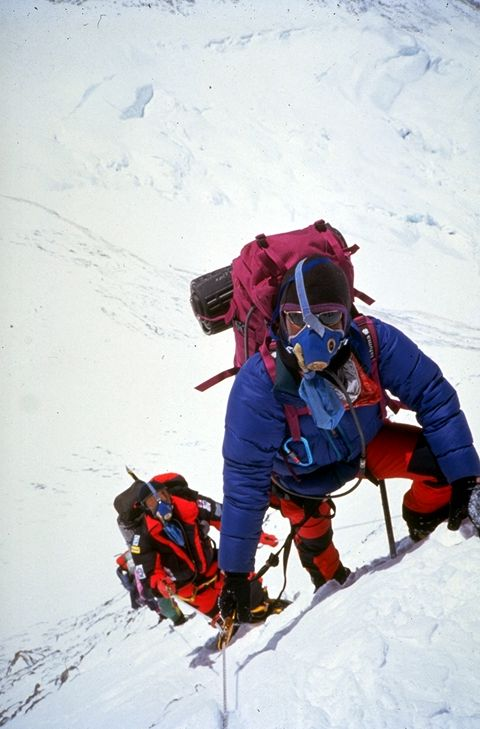
Moving Up Again at last! Dr. Shani Tan We had a cold clear night in Base Camp and in C2 ( Camp Two ). Early this morning five climbers; Justin, Edwin, Roz, Swee and Robert moved out from C2 to C3 (Camp Three). There were at least 30 climbers from various expeditions making their way up the fixed ropes towards C3 this morning but there was no undue congestion. All our climbers were safely in C3 by 1500h today. David still has pain in his right chest due to a ligamentous strain or pulled muscle. ( an earlier ultrasound by the Yale medical team ruled out a fractured rib. ) It has improved somewhat with painkillers but is keeping him in C2 for the time being. David’s present position at C2 is a logical one for coordinating movement of climbers and sherpas between BC and the higher camps, especially at this critical time. Mok,Leong and the remaining sherpas left BC at about 0630h this morning to make their way through the Ice Fall towards C2 bringing with them more supplies including sleeping mats, Marmite, Power Gel and Clif Bars. At the 1400h radio call, Leong was about 15 minutes from C2 with Mok 45min to an hour behind. With Mok in C2, we now have a medical presence there which would make the management of medical problems easier. ( there are in fact 4 other doctors up in C2 presently – 3 from the Environmental Expedition and 1 from Himalayan Kingdoms – but given the movement of climbers up and down the mountain and differing time schedules of various teams, it is always better to have “one of our own chaps”. ) Complex problems will be dealt with in consultation with BC. Tomorrow, Mok,Leong and David will remain at C2, whilst the sherpas will move from C2 to C4 with more supplies. Weather permitting, climbers in C3 who are well rested and strong will move up to C4.
Solo Spaniard descends Lhotse
The solo Spaniard,Inayke, attempting Lhotse descended down the fixed ropes past our climbers going to C3 just after noon. He reported being snow blind ( extent unknown ) but said that he was confident of making his way down the fixed ropes but requested shelter, food and water at our tents in C2. Pasquale Scaturro, a climber from the Environmental Expedition has made his way to the bottom of the fixed ropes to escort him across the glacier to our guys in C2. Once in C2 we will treat his snow blindness with medications from our kit. Another climber, believed to be the Swiss Andre Georges, attempting Lhotse was seen descending very slowly towards C3 – at the time of this report, it is not known if he was succesful in his attempt.
Weather report
Bracknell report just in at 1245h today said that the winds over the summit for the next few days would remain favourable for a summit attempt. The cyclone sighted on the 10th parallel just north of Madras is still there but is still in the formative stage. The presence of this weather pattern has been confirmed with satellite pictures from several sources. The cyclone, is fortunately still in the formative stage and therefore moving very slowly. Howevever, once it is fully formed, it can move at high speeds. Using their computer model to predict the path of the cyclone, Bracknell reports that it appears that it may move towards Calcutta and northwards, albeit slowly at the present. It is however sizable and a significant amount of precipitation is expected when it moves over land. The movement of this weather pattern is being put through the computers at Bracknell twice a day, at 0600 and 1800h GMT and with each simulation run, the prediction becomes more accurate. We are therefor in contact with the meteorologists twice a day to remain updated on the matter. At the present it appears to be about 72h away and once the cyclone actually forms up, we will have about 48h reaction time to get climbers off the mountain.
The Jet Stream
This is of great importance when climbing 8000m peaks as the summits may well jut into the Jet Stream if it descends. At the present time, the jetstream is quite high – accounting for the relatively low wind speeds at the summit – today’s being 20 knots and far north. Ironically, the jet being quite far from the Everest region is one of the reasons why the cyclone may proceed northwards towards us
Camp 4, 8,000m, Monday, May 18th 1998, 1535 hours
Ready for the Top! Dr. Shani Tan, reporting from Base Camp
Weather : Very bright hot and sunny in the morning becoming overcast and cool. By 1430h, it has just begun to snow here in BC. We had a relatively warm night in BC. Early this morning five climbers, Justin, Edwin, Roz, Swee and Robert moved out from Camp 3 to Camp 4. They had spent the night sleeping with supplementary oxygen and at the 0600h radio call said that they had slept well. They were moving well and ere in C4 by 1400h radio call. There they will rest and rehydrate. They are now ready for a summit attempt. At 1200h today we received news in Base Camp that a sherpa from Himalayan Kingdoms was struck on the thigh just above the knee by a piece of falling ice the size of a football. There was a big swelling over the site and he was in great pain. As the location of the incident was at the Geneva spur, a rescue team consisting of members from the Environmental Expedition assisted him up to lower Camp 3 – using a combination of the sherpa moving upwards on his own butt and hauling up on his climbing harness. Due to the difficult terrain, the rescue took nearly 3 hours before he was safely in one of our tents in Camp 3. A coordinated effort between Base Camp, Camp 2 and Camp 3 is in progress even as I write to try and get a splint and painkillers up to Camp 3. An aluminium stretcher is also being organised to bring him down through the icefall hopefully tomorrow.
Weather report
Bracknell report just in at 1245h today said that the winds over the summit for the next few days would remain favourable for a summit attempt with low wind speeds. The cyclone sighted earlier is now on the 14th parallel north and is moving slowly but surely north. It has tracked in a slightly more easterly direction but we will still receive significant precipitation although the winds would be pretty much dissipated by the time it gets to the Himalayas.
Camp 4 and Summit, 8,000-8,848m, Tuesday, May 19th 1998, hours
Ready for the Top! Dr. Shani Tan, reporting from Base Camp
Weather : Very bright hot and sunny in the morning becoming overcast and cool. By 1430h, it has just begun to snow here in BC. We had a relatively warm night in BC. Early this morning five climbers, Justin, Edwin, Roz, Swee and Robert moved out from Camp 3 to Camp 4. They had spent the night sleeping with supplementary oxygen and at the 0600h radio call said that they had slept well. They were moving well and ere in C4 by 1400h radio call. There they will rest and rehydrate. They are now ready for a summit attempt. At 1200h today we received news in Base Camp that a sherpa from Himalayan Kingdoms was struck on the thigh just above the knee by a piece of falling ice the size of a football. There was a big swelling over the site and he was in great pain. As the location of the incident was at the Geneva spur, a rescue team consisting of members from the Environmental Expedition assisted him up to lower Camp 3 – using a combination of the sherpa moving upwards on his own butt and hauling up on his climbing harness. Due to the difficult terrain, the rescue took nearly 3 hours before he was safely in one of our tents in Camp 3. A coordinated effort between Base Camp, Camp 2 and Camp 3 is in progress even as I write to try and get a splint and painkillers up to Camp 3. An aluminium stretcher is also being organised to bring him down through the icefall hopefully tomorrow.
Weather report
Bracknell report just in at 1245h today said that the winds over the summit for the next few days would remain favourable for a summit attempt with low wind speeds. The cyclone sighted earlier is now on the 14th parallel north and is moving slowly but surely north. It has tracked in a slightly more easterly direction but we will still receive significant precipitation although the winds would be pretty much dissipated by the time it gets to the Himalayas.
Look at the weather updates at the Weather Channel!
outh Summit, 8,751m, Tuesday, May 19th 1998, 1600 hours
Day of hope, tension, excitement and disappointment Dr. Shani Tan, reporting from Base Camp
Night long vigil
We had a warm and foggy night in Base Camp (BC). Up in Camp 2 (C2) and Camp 4 (C4) our climbers had a much better view of the night sky on a nice warm calm night. Expeditions in BC with members in C4 poised for a summit attempt were getting ready for a night long vigil. As our Base radio set was non functional due to a faulty antennae, after dinner, Shani and Johann met with members of the Wally Berg ( GPS ) and E3( MIT ) team in their communications tent. ( nicknamed the Bruton Dome, after Jim Bruton, their communications specialist ). By 2200h we were settled in for a long night, sitting either on equipment boxes or more lying comfortably on the floor in sleeping bags. Although there was almost a party atmosphere, it was obvious that we were all quite tense and anxious about the events to come. All the time, the Base radio set was set to scan through the frequencies that were being used by the teams on the mountain. Meanwhile up at C2 in the late afternoon, David was becoming more and more anxious as some of the Sherpas who were going up from C2 to C4 to support the summit push had not yet arrived – and the summit attempt was in danger of not proceeding. Eventually they arrived, 3h late, having created a great deal of tension down in C2 and BC.
Keeping a close tab with radio calls
1900h Our team of climbers – Justin, Swee, Roz, Edwin and Robert had just finished brewing up and re-hydrating as best as they could and were settling in for a final 2 hours of rest before getting ready for the summit push at 2300h. 2100h Swee radioed to say that all were resting or sleeping. 2300h Summit team leaves C4, moving on supplementary oxygen.
Steady progress through the night
Through the dark hours of the night, the pack of climbers and Sherpas, numbering easily 40 in all, made their way slowly up towards the summit. In front was Eric Simonsen and team from the GPS Expedition. As this was the first summit attempt of the season, there was no fixed rope and the front runners fixed rope as they went along. At about 0300h, a bright half moon arose to light the way. All this time, we were monitoring any radio transmissions that were coming from the summit teams as was David, in C2.
Excitement mounts in BC
After receiving word from the front climbers that they were near the South Summit, the excitement and tension in BC was palpable. Everyone was eagerly anticipating a successful summit, given that the South Summit is less than 100m below the true summit. 0600h Swee called to say that they had passed the Balcony and were probably 2h from the South Summit (8751m ), however with the deep snow, large number of climbers and with rope fixing in progress, the movement up the mountain had slowed down. Although breathless from exertion and rarefied air, he sounded strong. They had made good time and we were optimistic for the team.
Great disappointment and ensuing drama
0910h Swee called to say that they were now at the South Summit – normally, this point is roughly about 1 – 3 hours ( and about 90 vertical meters ) from the true summit (8848m) depending on the speed and strength of the climber and the conditions on the mountain. Unfortunately at this point, there was no more rope to be had for fixing the route. Eric Simonsen, an experienced guide, together with several Sherpas with multiple Everest ascents under their belts made an assessment of the remaining route up to the Hillary Step. The Hillary Step is a notorious steep rocky step which has significant objective danger. This 40 ft step is a point on the route that is often congested with climbers trying to ascend and descend the same rope. There was too much fresh snow and wind slab to make climbing that section without fixed rope extremely hazardous. A fruitless search for old rope from previous expeditions. At the same time, the wind was rising – approximately 70 kph and clouds were fast approaching. Given the situation and after conferring, all climbers on the South Summit turned back towards C4. 1100h We heard reports that a climber from another expedition had run out of oxygen and had “collapsed” on his descent from South Summit, at a location approximately 400m from the balcony. David received requests for assistance from the leader of that expedition, and after an assessment our our own summit team’s situation and oxygen supply status offered an oxygen cylinder from our own supply cached on the descent route. Fortunately, the climber’s own Sherpas found him and quickly brought him a fresh supply of oxygen. The climber in question has since been “short roped” and helped down to the South Col. He was able to move without assistance and it is hoped that his condition is stable. At time of report, no further update is available on his state of health. 1430h All our climbers are now in C4, tired and dehydrated but safe and sound. With this radio call, we received a news that there were 2 accidents involving a climber and 2 Sherpas from other expeditions. Apparently, the exhausted climber tripped and fell, rolled 100m down the slope, knocking down a Sherpa in the process. The two were helped up and assisted into C4 by nearby climbers. Another Sherpa also tripped and fell and was similarly helped into C4. The condition of these three persons are at present unknown.
What next ?
The summit team will rest tonight at C4, using supplementary oxygen and will then make their way down to C2 tomorrow. The support team in C2 will descend to BC tomorrow bringing with them non essential equipment from C2 and C1 as a precautionary measure in case the coming snowfall should bury the gear. Sherpas will also assist in bringing down empty oxygen bottles. A reassessment of the oxygen supplies will be made once the summit team has descended from C4 to C2 and a plan formulated for a second attempt should a second weather window present itself in the last week of May.
Injured Sherpa update
By 1700h yesterday evening, the casualty was safely in one of our tents in C3 and Shani Tan and Ken Kamler, Expedition Doctors with our team and Wally Berg’s team were advising the rescue party in C3 on the improvisation of a traction splint to immobilise the injured Sherpa’s fractured femur. Fortunately, in the rescue party there were experienced Trauma specialists and Emergency Medical Technicians who were invaluable in the immediate assessment and treatment of the casualty. Arrangements were also made in the following hour to send up more medical supplies and a aluminum “skid” to C2 early this morning. At 0600h this morning, 2 of Wally’s Sherpas left for C2 with the “sled” and medicines and by 1000h efforts were being made to get the Sherpa down the Lhotse Face. By the 1430h radio call, the casualty was being slowly lowered down the Lhotse Face – Mok our climber/doctor in C2 is on standby awaiting his arrival.
Weather report
Bracknell report just in at 1245h today said that the winds over the summit would remain low for tonight and tomorrow night at approximately 30kph, but will increase significantly to 80 – 100khp over the weekend, with increasing precipitation. The cyclone threat is somewhat less as the tropical storm has taken a more easterly direction, however, the forecast is that we will be receiving at least 25 – 50 cm of snowfall. The Jet Stream, presently still at 34th parallel north is reportedly moving southward, which may account for an increase in summit wind speeds over the weekend.
Camp 2, 6,700m, Wednesday, May 20th 1998
Summit Team back in Camp 2 Dr. Shani Tan
We are back in Camp 2 The summit team rested on supplementary oxygen in C4(Camp 4) overnight and began their descent to C2 (Camp 2) at 0900h this morning. On the radio they sounded tired and frustrated. The support team in C2 left for BC (Base Camp) at about the same time carrying heavy loads as we have begun to remove non-essential items from the upper camps. Mok, David and Leong reached BC between 1330 and 1400h and are now resting. The summit team reached C2 between 1230 and 1300h. They will be spending the night there. Climbing is a cooperative effort between Expeditions on the mountain. Our team did not run out of rope – NOTE – that different expeditions take turns to “fix rope” on different sections of the mountain.Our responsibility was to fix the section between C2 and C4 and to provide Sherpas to help with section from C4 to South Summit. The section from South Summit to True Summit was the responsibility of Wally Berg’s American expedition. They had undertaken to fix line on this tricky section. We are very disappointed and frustrated that the expedition in question did not check that they had enough rope and as a result dashed the hopes and dreams of so many people ( 60+ on summit day from over half dozen expeditions ) including our team.
Singapore Base Camp reacts with disappointment and frustration Yesterday, our Base Camp was in deep depression – our kitchen staff had also kept and all night vigil as the climb was in progress, and the kitchen boys made regular trips out into the cold to make sure that the juniper sprigs and incense was kept burning on our puja altar. Our cook told us later that evening that he “normally does not drink – but after what had happened in the morning, he felt so bad that he had to have a bottle of Khukri rum to drown his sorrows. Later that evening, as if in commiseration, a thick dense fog enveloped Base Camp. This morning as we went about our daily tasks preparing for the climbers return, the feeling of frustration was made even more bitter as we heard shouts of jubilation from nearby camps which had climbers on the summit today. The route all the way to the South Summit today was that much easier for this second group of climbers as the path had been stamped through abd rope fixed by yesterday’s summit teams. It remained for the lead climber and a Sherpa who was a 10 time Everest summiteer to fix the route up from the South Summit through the Hillary Step. Ironically, one of the teams to succeed was the one which had undertaken to complete the fixing of the safety line from the south summit to the Hillary Step- but failed to do so yesterday when the Singapore team was making its bid.
Drama and rescue whilst others summit : Even as shouts of jubilation were echoing around Base Camp, there were some expeditions with members injured in yesterday and last night’s attempt who were desperately making radio calls for help. A climber on C4 had succumbed to High Altitude Pulmonary Edema ( HAPE ) and another had taken a fall in the early hours of this morning and was suspected to have fractured his ribs. Even on a good clear summit day, such is climbing on Everest, that there is such a mixture of emotions – joy, anxiety, sorrow and pain. As with any incident on the mountain, climbers near the casualty are drawn in to assist, wether or not that person is from their expedition, often using their own precious resources of oxygen, medications,equipment, physical and mental energy.
Injured Sherpa Update: The rescue party lowering the Sherpa to C2 finally got into came in darkness at around 2100h. Once they were in camp, they put the casualty on a traction splint and gave him more fluids by mouth as he had put out only 300ml of urine during the day. By 1600h he had made his way down the Ice Fall assisted by 3 fellow sherpas. Amazingly, he was able to walk with 2 ski poles unassisted once he got into BC. After some food and drink, he was examined by Ken Kamler and Shani Tan who were doubtful about the diagnosis of a fracture. He had a large painfull swelling above the knee and was unable to bend the joint but there was no crepitus or angulation seen. He was put into a long leg splint and a decision was made not to call in a helicopter immediately but to wait a day or two to observe his progress.
Weather report : Bracknell report just in at 1245h today said that the winds over the summit would remain in the 30 – 35 knots range over the next few days and that the cyclone, now named cyclone B1 has dissipated in the South East. However there will still be snow showers increasing towards the end of the month as the Monsoon approaches. The Jet Stream is now reported to be remianing stationary in the North, giving us moderate winds which will be compatible with another summit attempt albeit by strong climbers.
Camp 2, 6,700m, Thursday, May 21st 1998
Waiting for the next weather window Dr. Shani Tan
Hot weather in BC (Base Camp) It was very bright hot and sunny in the morning becoming overcast and cool by 1700h.It has been increasing warm in the last few days and the camp sites all over BC are slowly melting away.Often huge boulders 3 – 5 feet across are left teetering on ice pedestals a mere 1 foot in diameter posing a hazard as they tend to topple over unexpectedly. BC personnel give these interesting structures a wide berth as they walk by them. Throughout the day and night we hear the rumble of rock slides and avalanches from the mountainsides all around us as the warm weather melts the ice and snow holding the rocks and boulders together.
Climbers in C2 stay put Justin, Roz, Robert,Swee and Edwin are now in C2 (Camp 2) waiting for the next weather window. Meanwhile in BC, we have been packing nutritious foods and snacks for the sherpas to bring up to them tomorrow. All our climbing sherpas descended from C2 to BC for rest today,bringing down with them empty oxygen and propane cylinders, excess tents and nonbiodegradable rubbish. All Expeditions are required by the Sagarmartha Pollution Control Committte to show evidence that they have packed out all that they have rbought in to the National Park. Failure to do so wold mean a forfeiture of the bond held by the
SPCC.
Non essential equipment were packed away to reduce the time needed for breaking of camp at the end. David also spent the morning negotiating extra oxygen supplies for the next summit attempt as the oxygen usage strategy will be different. We are assessing the weather report daily and working out oxygen configurations such that a second wave of 2 climbers and two sherpas may be possible.
More Casualties on the Mountain :
Yesterday’s succesful summit attempt by 6 Americans, 4 Iranians and their sherpas left in its wake yet more casualties. Of the team of 10 Americans from one Expedition, 1 did not even leave C4 as he was feeling unwll and another had unsurmountable problems with his oxygen regulator. 2 more left C4 but fell on route to the summit at the same spot where 3 other climbers had fallen during descent the day before. One broke a number of ribs and injured his knee and is now facing problems being evacuated to BC, and the other lost his sunglasses during the fall and quickly became snow blind and had to crawl back into C4. A climber on that expedition stayed behind to tend to his fellow members. The climber reported to have HAPE ( high altitude pulmonary edema ) yesterday was helped down to C2 by 3 sherpa and was reported to have improved and spent a relatively comfortable night there. The condition of the sherpa with the “broken Leg” has remained unchanged – so he might yet require helicopter evacuation, perhaps when the climber with fractured ribs gets back down to BC. These casualties are reminders of the high stakes and penalties of mistakes of high altitude climbing.
Camp 2, 6,700m, Friday, May 22nd 1998
New summit team named Dr. Shani Tan
Summer approaches.. bringing havoc..
It is definitely approaching summer, the day time temperature is rising and there are “rivers” running through the BC, under our mess tent and kitchen. These created undrground tunnels and everything is sinking. Our individual tents are also collapsing. There are more than ever rock and ice avalanches, heard and seen continuously day and night.
Second Summit team Climbers in C2 stay put
The second summit party of 2 climbers and 5 sherpas was announced last evening. It comprises Swee chiow and Edwin, with the following five sherpas: Ang Dorje Sherpas, Kami Rita Sherpas, Lakpa Sherpa and Nawang Sherpa as summit sherpas and Kunga Sherpa ( deputy sirdar) as support sherpas from southcol. TheTeam is expected to move camp3 tomorrow and camp 4 the day after. Summit day will be aimed at 25/5. Robert and Rozani returned from camp 2 to BC today, reaching Bc about 1pm. Justin is staying out at C2 acting as support staff. Two sherpas, Dawa Galzen and Phurba Sherpa had carried supply of fresh rations to C2 to muscle up our summit team. David continued to spent the morning negotiating extra oxygen supplies for the summit attempt. So far we managed to secure all the oxygen requirement. The Iranian team leader was helpful, so were some American expeditions, thanks to our leader’s good relationship with them.
Casualty evacuation on the Mountain
Further to the drama that happened, today’s drama continues. The injured American climber, with broken ribs was being evacuated down from C2 to BC. Unfortunately, the American thought the almighty Singaporean team had “volunteered” to help them. We suddenly received a call from the American BC manager in the morning, regarding when we are sending our resue team to help them bring down casualty, when we are totally in the dark. The sherpas bringing down the casualty were exhausted and needed extra hands at the icefall. They needed 3 more sherpas from the Singapore camp to help. Interestingly, the American expedition have more than 5-6 climbers in the BC, and they are not helping! Finally it was cleared up that it was a misunderstanding. The Americans finally sent their own cimbers to assist their casualty. As of 1730hr, they are still coming down the icefall, probably will reach BC at night.
Friendly Visit from S’pore
Three of Johann’s friends from the NUS, dropped by to visit us in th late morning. Brought along some goodies and magazines to stimulate our hypoxic brains.
Camp 3, 7,200m, Saturday, May 23rd 1998
Edwin and Swee go up to Camp Three Dr. Shani Tan Justin is remaining in C2 in support of the 2nd attempt. Swee and Edwin left C2 at 0700h this morning for C3 with sherpa support to carry their equipment so as not to tire them our unduly. Our sherpas in support of the summit attempt will move from C2 to C4 tomorrow to meet Ed and Swee as they arrive in C4 tomorrow afternoon. Other sherpas not involved in the summit push will be clearing up empty gas cyliners, dismantling tents which will not be used in the push and bringing these down to BC. We managed to buy sufficient oxygen from other expeditions to allow the second attempt to proceed. To offset the cost of new Poisk bottles we also managed to sell some of our LSE bottles ( a different type of oxygen bottle ) to another expedition. We needed to buy new Poisk bottles because of a change in the oxygen usage strategy which called for more small Poisk bottles and fewer large LSE ones.
Injured Sherpa reassesment
Shani reassesed the sherpa today – his thigh is less swollen but he is still unable to bend his knee. There is still pain on movement but he is able to move about with the aid of 2 ski poles. As the trek out of BC is over rough terrain, it is anticipated that he will not be able to cover the ground without aid and a helicopter evacuation is scheduled in as few days time, when the climbing guide of his expedition returns to BC. The guide attached to his expedition needs to get back to Kathmandu as soon as he is back in BC as he has another expedition to go to. As such a helicopter extraction of both guide and sherpa is planned.
Injured climbers return to BC
The 2 American climbers injured during the summit attempt of the 20th returned to BC last night. The epic evacuation from C4 to BC has taken 3 days involving much manpower. The last leg of the rescue involved moving the aluminiun mountain stretcher or “sked” throughthe Ice Fall. For able bodied climbers, moving quickly through the Ice Fall is a hazardous business, usually undertaken in the early hours of the morning when the Ice is still hard and anchors are firm. When a large rescue party is moving slowly through the jumbled ice in the late afternoon and then into the dark of the night, the dangers are multiplied. They arrived in BC just after midnight after a long and ardous journey. The less injured climber who sustained snow blindness and minor knee injury was in good condition and moving under his own power. The more seriously hurt climber was moved into BC on the sked. He had sustained a badly twisted knee and fractured ribs with underlying renal contusion. He was much better this morning and walking slowly with help and was being tended to by the doctors in his own Team.
Minor surgery in BC
One of our kitchen boys presented with a tense and badly swollen right thumb after sustaining a puncture wound to that thumb. Mok and Shani drained the abscess under a digital block. He will have daily dressing to the infected part until it heals.
Weather report
The winds over the summit for the next few days are reported as moderate, compatible with a summit attempt by fit and strong climbers. There will also be occasional showers of snow. Next Steps : Ed and Swee will move to C4 tomorrow to be in place for a summit push late Sunday night.
Read Leader David Lims perspective on the Summit Bid
Camp 4, 8,000m, Sunday, May 24th 1998
The Second Attempt Dr. Shani Tan It started gusting at BC shortly after 2100h last night and continued to blow through the night and into late morning. It gave us a bit of worry although these concerns were put to rest when the radio call to C2 at 0800 reported calm and still conditions.Indeed looking up into the Ice Fall and at clouds over the tops suggested that the winds at BC were stronger than those higher up. It continued to be a scorchingly hot day as we packed up more kit and equipment in preparation for our departure from BC either on the 29th or 30th May. Some of the excess medicines, bandages and dressings from the medical kit will be donated to the Himalayan Rescue Association clinic at Periche when we stop at the village en route to Syangboche from where we will helicopter out to Jiri.From Jiri we will load up a bus and a truck for a 6 – 8h bone jarring road journey to Kathandu. Due to new transport regulations, we are no longer allowed to helicopter passengers and cargo out from Lukla to Kathmandu. Any flights from Syangboche or Periche to Kathmandu now have to be charter flights at a cost of USD2000 per hour ( making a cost of USD 6000 per flight which takes only 7 passengers with cargo ) and our expedition budget ( one of the smallest at this BC this season ) does not allow us the luxury of that. Even the hotel that we are staying in is a low budget traveller’s hotel in Thamel compared with the 5 star international standard Yak and Yeti where the American expeditions are staying. Even the Iranian expedition had 1.5 metric tonnes of food alone – which exceed our total baggage allowance of 1.3 tonnes which included personal baggage, climbing equipment and food. Our sherpas for the summit team left C2 at 0500h for C4, stopping at C3 along the way to help Ed and Swee with their down suits and sleeping bags. Unfortunately, one of the sherpas who was supposed to have gone up to C4 purely in a support role developed a sore throat in the early hours of this morning leaving us short of one pair of hands. Ed and Swee left C3 at about 0900h and got into C4 just after 1400h. After arrriving, they spent some time checking to make sure that the oxygen bottles that we had purchased from the Iranians and Himalayan Kingdoms were there. They will spend the next few hours resting and rehydrating as best as they can and hopefully will be able to eat some food to sustain them for the long night ahead. Ed and Swee plan to leave C4 at approximately 2100h for the summit push. Back in BC, we are again preparing for a long cold night vigil as they make their summit attempt. The other climbers on the mountain at C4 tonight will include two guides and 3 clients from Himalayan Kingdoms and a solo Bolivian with their respective sherpa support.
Weather report
The winds over the summit for today and tomorrow have been reported as between 30 – 40 knots by Bracknell and slightly less by MSS. There will be no significant precipitation expected over the next 2 days.
Leader’s Account of the First Everest Summit Bid
David Lim Summitting a major peak is always a prize; the bonus; the payoff after many weeks or months or deprivation and work. Getting a chance to summit a mountain like Everest is a rare opportunity. When I climbed up to Camp 2 at 6500m, I was part of a seasoned summit team of five. As leader, it is vital to have a grasp of the backend aspects of an expedition such as the flow of supplies up the mountain especially mission-critical equipment like bottled oxygen. On the sharp end of things I also believe it is also important to be able to organise and help the team focus as a climbing leader.
THE SWITCH
To my deep disappointment, the dry coughing fits which plagued me recurred and one bout led to my either tearing a rib cartilage or cracking a rib. This was the diagnosis of three american doctors from Bob Hoffman’s expedition. The pain was very significant and I then had to give my place to Edwin Siew who I knew was fit and strong.This was not the first time, as an expedition leader, I felt that my summit team slot was better served by another team member, difficult as it was from a personal perspective.
SNOW AND TYPHOON WARNING
The 3 days that followed surprised me in their intensity and nerve-wracking quality. From Camp2 on the 17th, the team of 5 ( Justin, Rozani, Edwin,Swee and Robert ) moved swiftly to Camp 3 on the icy Lhotse Face. This was preceded by 2 days when snow and subsequent avalanche risk precluded the push up. By this time, many other teams were also moving into position and I was already anticipating a crowded summit day on the 19th. In the meantime, we had been receiving daily weather reports from Bracknell which indicated a typhoon was building up over India and might be moving up north to us. If it hit us. several feet of snow would be dumped and it would shut down the mountain for the rest of the season and end all climbing for this season. The movement of the typhoon and our team up the mountain was to be tracked closely. Everest is such a huge mountain that retreat in quick time is very difficult and thus have to be planned carefully. I was counting on the other big expeditions to also do their part in the fixing the safety line over the tricky sections of the virgin route this season. On the 18th, a long line of climbers could be seen from C2 ascending to Camp 4 – over 60 climbers and sherpas in all.
HIGH ALTITUDE DRAMA
It was after the team reached C4 on South Col, the flat saddle at 8000 metres that some drama began to occur. Information was patchy but at about 1230pm, Apa Sherpa from Hoffman’s team came to us to report that a sherpa from the Himalayan Kingdoms Expedition ( HKE ) had been injured and was at C3. Shortly after, the sole sherpa left at their C2 came over and asked for bandages for their sherpa whom he believed had a ‘cut’. We gave him this and he pounded off to C3. Only a 230pm on the radio did we receive a call from Rob Morrison ( Hoffman’s team ) that he and a few others had helped the sherpa into C3 and he appeared to have much more serious injuries than thought – a broken leg from a falling rock. Eventually, it transpired that members of Hoffman’s team had helped him into our tents ( we offered their use of it and our b ottled oxygen as well ). Jim Williams, assistant guide of (HKE) borrowed a radio off from Hoffman’s team and proceeded to C3 as did Sandip, their client and doctor. Through the day, we heard no news from Dave Walsh ( chief guide for HKE ) and the HKE summit team now at C4 on south col, nor did they send sherpas down from south col to help. Dr Mok and I requisitioned medical supplies and thankfully, Jeff Rhoades from Everest Challenge agreed to move them up to C3 as his team were making a push to south col that evening and C3 was en route. We ourselves had no sherpas and were in no condition to ferry these up to C3. To make matters worse, 3 of our own sherpas had failed to arrive at south col by 4pm and I was ready to abort the summit push the next day to look for them. Thankfully, by the 6pm radio check, they had turned up, tired but safe. The summit push was on
SUMMIT DAY – WINDS, BROKEN PROMISES, AND DISAPPOINTMENT
The summit team rehydrated and slept for too few hours at south col before preparing for the big push. MB, my chief sherpa, had obtained promises of support for helping to break trail in the new snow from 6 other chief sherpas from other teams. Altogether there was likely to be sufficient fixed safety line to cover most of the route. At 10pm, 2 of our sherpas left to lead the trail and fix line. However, few , if any of the others left with them.The team and the 5 support sherpas left shortly after.Breathing bottled 02 in the rarified atmosphere at 2.5 litres a minute, progress was good despite the large crowd and the team reached the Balcony in the lead pack at about 4am. The Balcony is a small ledge and a landmark on the summit route. The rest of what happened is largely contained in Dr Shani Tan’s report. The team reached the south summit, 150 vertical metres from the true summit and one hour from the true summit at 9 – 930am. A large crowd began to build up behind them as the problem began to become apparent. The terrain between the south summit and the top was dominated by a tricky ridge covered with avalanche prone snow – on the right, a 3000m drop to Tibet and on the other, a 2000m drop off the southwest face. No one was prepared to go across without a belay from a rope or the use of a safety line. None was available! Through sheer bad luck and lack of support from the larger teams, sections below had been over-protected and the larger teams had failed to bring sufficient or any rope; relying on the few ( including our team ) to fix the route. particularly galling was the broken promise of Wally Berg’s team who had undertaken to fix this section of the route weeks before. 2-time Everest summmitter and guide on Wally’s team, Eric Simonson, recalled later how he had instructed his sherpas to ensure they had fixed line and equipment for the route. They failed in this respect. Winds began to pick up significantly after 930am and everyone turned around and made an arduous journey back.Some careless climbers ran out of oxygen and the strong winds and softening snow made the final return dangerous. Several climbers fell 100-150 metres just before the south col but without fatalities. All this time after the turnaround, radio contact with the team was sporadic and concern was felt by all at C2 until all reported in safe at the designated radio check times. Exhausted as they were, both Robert and Edwin expressed an interest to have another go. Robert said: “ This is the 1st Singapore Mt Everest Expedition. We must give it another try!”
AFTERMATH AND THE MEDIA
Owing to a last-minute request by our sherpas to use extra oxygen for themselves on the climb; our reserves for a second attempt were badly depleted. This, and the exhausted state of the members meant a descent was imperative. Only the stolid and incredibly fit Iranians managed to pull off a successful summit bid the next day from south col with the same team. Everyone else descended. I was really proud that we came within a whisker of putting not one but 5 members on the summit. As far as I was concerned, we had done almost everything to get the job done but was let down by other teams who did not share the work on that fateful day. I was less happy about the way the media played up the “ lack of fixed rope” as the chief cause of the failure to summit. The winds were building, and the avalanche slope would have made a crossing tricky at best. The lack of fixed line compounded the whole problem. Reports by The Straits Times and TCS Channel 5 suggested incompetence on our part. We already pointed out previous mispellings and several other glaring factual and situational errors by the ST and this further ill-informed reporting only exacerbated our feelings of frustration. Later, The New Paper published a rather mocking article along the lines of “ Why must Singaporeans find excuses for failure? “ – referring to our unsuccessful bid. It seems, in the media at least, editors and journalists prefer to be negative and critical rather than upbeat or supportive when their countrymen are battling against time, the weather and the elements. To websurfers from Singapore, I sugggest checking out our site for the most accurate information. Others merely ‘lift’ what they want you, the reader, to read and publish/broadcast this in their media. We have a second summit attempt in a few days and everything to play for. Wish us better luck this time.
>> Read March’s dispatches
>> Read April’s dispatches
Summit push vigil starts
After dinner last night, we begun an all night vigil. Our sirdar organised the kitchen boys to keep the fire on the puja altar burning all night. In the cold clear night, they sat infront of the altar feeding it with juniper sprigs and incense. Meanwhile the rest of us kept a listening ear out for radio calls from Camp 2 and Base Camp. 2200h The team of Swee, Ed, and sherpas Ang Dorje “Phulilie” Sherpa, Nawang Phurba Sherpa, Kami Rita Sherpa and Fura Dorjee Sherpa left C4 using supplementary oxygen. In support in Camp 4 was Dawa Gyalzen. They were accompanied closely by Bernardo Guarachi, hoping to be the first native South American Indian to summit Everest. They made steady progress and fixed rope on the tricky sections of the Balcony where several people had fallen over the past few days. 0500h Radio call from the summit team reported that they were now at the South Summit. 0530h Radio call from Dorje said that they were now at the South Summit with only 10 minutes more to go before reaching the True Summit. The tension was palpable as we waited for the call to say that they had reached the summit. 0600h SUMMIT !! at last ! We heard Edwin saying “ …looks like I have reached the vertical end of the earth !! “ Cheers rang out from all of us who had kept the long vigil through the night and members from other Expeditions who have not yet left BC came and offered congratulations. Bernado, the Bolivian was right up there being one of the first summiteer of the day and the first Native South American Indian to be on top of Everest. Although we were very happy that they had reached the summit, our guys still had to make a safe descent. We knew very well that many accidents occur on the way down when climbers are tired. We silently prayed for a safe journey back down to Camp 4 for our climbers. The summit team spent some time on the summit taking photographs ( unfortunately the videocam malfunctioned and no video footage was taken – also due to difficulties with radio reception, we could could not confirm the total number and condition of the summiteers for about 2 hours ) 1200h Safely back in C4 at the South Col. We all heaved a sigh of relief. Radio comms was also easier now that they were down in camp. Speaking to them over the radio, they said that they were tired and but happy and in good condition. They plan to rest and rehdyrate and then descend to C2 where the air is thicker for a good rest. Ed and Swee will spend the night at C2 – depending on their condition, they may either rest for another day there or return to BC the following day.
Summit!, 8,848m, Monday, May 25th 1998
Looks like I have reached the vertical end of the Earth !” Dr. Shani Tan
Reaching the Top!
Dr Shani Tan, Team Doctor from Base Camp
Helicopter rescue at BC
The American climber from the Environmental Expedition who sustained fractured ribs, renal contusion and a sprained knee took a turn for the worse this morning with decreasing urine out. Bruce, Shani and 4 members from his expedition took shovels and pickaxes and went out the Landing Point prepared several weeks before for and eventuality such as this. It took us about 40 minutes to level and cover the LP with new gravel as the warm weather in the intervening weeks had made the surface unsuitable to landing. Meanwhile, arrangements were being made with the Nepalese Army to send in a chopper to evacuate the casualty. No sooner had we returned to BC ( a 15 minute walk ), we were told that the chopper was already on its way and the casualty was being helped toward the LP by 2 sturdy sherpas. A fellow American climber ran ahead over ankle twisting moraine to mark out the LP with brightly coloured tape. A huge MI 17 chopper thundered up the Khumbu valley towards us just as we approached the LP. The pilot made an expert landing on the small LP which just barely accomodated the wheels of his aircraft. As the air in BC is relatively thin, the pilot did not shut down his engines; fighting the downdraft and avidoing the deadly tail rotors, the casuaty was helped into the helicopter, doors secured and in a matter a 5 minutes he was whisked away to Kathmandu.
Triumph and Tragedy on Everest
This has been a season which has seen more summitteers on the North side than the South – highly unusual as the North is significantly more difficult and dangerous than the South. Even as we recieved the news of our summit teams success, we were also informed by another Expedition leader of the first fatality of the season – an American woman climber was reported to have died on the North side route yesterday.
Base Camp, Tuesday, May 26th 1998
Congrats all over! Dr. Shani Tan
Winding down :
The morning in Base Camp was spent packing tents and other gear which the Sherpas had brought down in the carry from C2 early this morning. Partially full oxygen and propane cylinders were purged of their contents to make them less hazardous to transport, especially as these items will be making the same helicopter flight as us. Tents were dried in the hot sun before being packed away in barrels. At 0745h we recieved news that 3 climbers on Henry Todd’s expedition had summited; Neil, Alan and Bear. 3 other members of that expedition are attemtping Lhotse tonight. Justin, Swee and Ed left C2 around mid morning for BC and arrived at 1430h. Swee and Ed were first into camp and greeted with great enthusiasm and joy by everyone at BC. They were asked to pose in front of the puja altar with the Ice Fall inm the background and everyone starting snapping pictures, video footage and getting quotes from them. ( a foretaste of the media frenzy to come ! ). Our website has been swamped with congratulatory messages from friends and supporters around the world ( and absolute strangers ! ) – we are very encouraged and thrilled by the response from everyone. Now that both Ed and Swee are back, we asked them the question : who was first ? – Ed was and followed 30 min later by Swee. Justin pulled into BC about 30 minutes later. All were very tired and had very irritable dry coughs but were otherwise on good health
Base Camp, Wednesday, May 28th 1998
Now it’s time to say goodbye… David Lim, from Base Camp
LAST TRANSMISSION FROM BASECAMP
This is it! The team is packing up the comms tent and as a result, this will be our last transmission from Basecamp. We have been based here for about 65 days. Tomorrow, the team’s only contact with Singapore will be via satellite telephone. The team leaves tomorrow for Pheriche and then to Namche ( 30th-31st May ). A day will be spent at Namche fulfilling the Sagarmatha Pollution Control Committee requirements. Garbage taken out will be accounted for as will our empty oxygen bottles. On the 1st June, we anticipate that we will be able to catch a helicopter from Syangboche for Jiri and then by bus to Kathmandu; arriving late on the evening of the first. Much paperwork and logistical diengagement will follow at various Ministries and the team is due to return to Singapore on Sunday, 7th June; thanks to Singapore Airlines.
INTERNATIONAL GOODWILL
Apart from a few disappointing instances where we were taken advantage of ( full details out soon ) by another expedition, the whole expedition generated much goodwill from climbers; many of whom knew little of Singapore. Instances of medical help we rendered to fixed rope and extra oxygen supplied by other teams just highlighted that as a whole, most teams worked together and contributed. We have made good friends and climbing contacts with climbers from the USA, UK, Bolivia, Sweden, Denmark, Switzerland and Iran. Future joint national expeditions are already on the cards! In addition, scores of Singapore flags in the form of lapel pins were given to our new friends – a reminder of the 1st Singapore Mt Everest Expedition 1998.
Singapore, Monday, January 15th 1999
Final Update David Lim, Expedition Leader
The Rope Thing
Much has been discussed above regarding the fixing of ropes on the May 19th summit attempt. In the press and a few Americn Web sites, our team has been villified as being whiners; as being presumptious etc etc on this issue. Perhaps I can clarify that there was no fixed agreement in the classic sense of the word. What happened was that for weeks before (even before Camps 3 and 4 were placed), Wally Berg visited more than one other expedition and stressed how it would be his team that would fix the line from the south summit to the summit. On May 18th, my head Sherpa at Camp 4 obtained agreements from the other expeditions’ Sherpas (eight in all) that thay would help in the trail-breaking and rope-laying for the summit bid. However, either more rope was used on lower sections or that an insufficient amount was brought (our own team had several hundred metres) because what we found was an exasperated Eric Simonson (Wally Berg’s team) berating his Sherpas for not bringing the right gear or sufficient rope for that section Wally had so often said he would fix. It is clear in my mind that whilst it may have been a Sherpa error/mistake, Wally has to accept responsibility for this and accept that this was a major reason for the failure of his team to summit that day—and in consequence, other teams which had relied on this information including our own first-attempt team. Later at Basecamp (after the 20th) — and to several expeditions, he explained the events of the 19th as being a case where there was actually SOME fixed line and equipment available to fix the route from the critical south summit to the summit but no one had the nerve to do so; indirectly blaming the intestinal fortitude of climbers of such calibre as Eric Simonson (!). When he himself summitted on the 20th, it was Apa Sherpa of Bob Hoffman’s team who was doing the lion’s share of the work; followed closely by PV Scaturro and Hoffman himself. Wally didn’t have a hand in the fixing of rope in any major way. Several other climbers not of this team were also pissed off with this oversight of the 19th. That they did not have a Web site or a ‘voice’ to the rest of the world did not in anyway make the disappointment any easier to bear. Kudos to the Iranians who had the immense stamina to repeat a summit push the same day after (20th); and succeeding.
On being taken advantage
A gracious report in the Mountainzone Web site thanked us for assisting in the retrieval of the GPS unit. The sad fact is that Wally took us for a bit of a ride: he contracted one of my Sherpas (without my knowledge) to retrieve the GPS unit on the 25th—on our summit, attempt! A bounty of somewhere between US$600–$1000 was offered and he gleefully told me this only after the fact. I find this a bit unbecoming, irrespective of whether or not the Sherpa should have cleared it with me first. I think it was naive of us to believe that everyone on the mountain would not take advantage of another team when the situation presented itself.
PRs and the nationality issue
Enough of this has been debated and I think there are enough right thinking people in Singapore to appreciate the fact that the whole four years of the project and the summitting has been a team effort and not to recognise it is an insult to the team. These ill-informed people only see the summitting as the only goal of the project and are miffed that the two were ‘merely’ permanent residents (PRs). Frankly, if those five climbers on May 19th had summitted, none of this codswallop would even be discussed—even if there were PRs in the summit team of the 19th. Mountaineering is not bound by such strict ‘nationality’ rules as the Olympics. In addition, the status of the team has been public knowledge for these four years and has been in all our publicity materials. Sir Edmund Hillary was (and still is) a New Zealander and Tenzing Norgay an Indian citizen at the time of their historic ascent of Everest. Our own Sportswoman of the Year is a Chinese national. No complaints on this so far. So, to those critics, spare us the double standards.
On money
Again, we draw unjustified criticism on the cost of the expedition. The four-year project raised about S$730,000 in cash and in kind; that’s about $180,000 per year on average. Everest alone cost US$250,000 or so. By comparison, our neighbours spent about ten times that much to summit Everest. By comparison, an opening ceremony of a recent football tournament here cost S$500,000 for about one hour of entertainment. About 6% came from public funds in the strict sense of the word ie contributions by the Singapore Sports Council. Up to August 1997, 40% or so of the costs of the training expeditions were borne by the team members. The President’s Star Charity is intended to aid charities and worthy causes. However, owing to the way the Television Corporation of Singapore’s portrayal of the event, it was suggested that only conventional charities are supported. This is not the case as many arts groups which aren’t normally viewed as conventional charities are also nominated and assisted in this way. I have not heard of any complaints thus far. We are grateful for the President nominating us in 1997 as a beneficiary and for his unwavering support these past few years. Our expedition not only achieved its goal, we also funded an educational exhibition Fire and Ice at the Science Centre and also was involved in a major Internet learning project on mountain environments administered by the Ministry of Education and 30 participating schools and junior colleges. To say it it merely benefited the climbers is, again, another malicious lie. Most importantly, it has helped inspire thousands of the Singapore public to believe in what can be achieved with vision and perspiration.Try putting a price on that.
On being home
Besides fighting stomach bugs leftover from our Kathmandu stay, most of the team are back at work and sorting out their public duties; catching up with family, friends and, of course Singaporean food. Soon, a donation will be made from our funds for a US$5000 mini-hydro electric project for the Himanchal School, Nangi Village, Annapurna region; leaving a lasting thing of value to the people of Nepal. This funding has also been made possible by contributors from Outside Magazine online’s chat-group—who once again have shown the power of the Internet and the generosity of strangers! I feel uplifted by those who stayed by their computer terminals, logging on regularly and wishing us godspeed up the Big Hill—and down again. To those whom we are unlikely to ever meet, once again, thank you.
The Official Report of the Expedition to Singapore Pools, the largest single sponsor is re-printed here:
The 1st Singapore Mt Everest Expedition, after 4 years of preparation, departed Singapore in mid-March 1998. The final team from Singapore comprised:
Climbing Members:
David Lim ( Expedition leader )
Justin Lean ( Climber/chief videographer )
Leong Chee Mun ( Climber )
Mohd Rozani ( Climber )
Dr Mok Ying Jang ( Climber/ medic )
Robert Goh Ee Kiat ( Climber )
Khoo Swee Chiow ( Climber )
Edwin Siew Cheok Wai ( Climber )
Support at Basecamp:
Col Bruce Niven ( Basecamp manager )
Dr Shani Tan ( Medical )
Johann Annuar ( Communications Officer )
AIMS:
As per the original 1994 prospectus, the project aims were to
a) climb Mt Everest as a mountaineering excellence project
b) broaden the base of mountaineers in Singapore( 13 climbers inducted 94-97, 8 chosen)
THE TOTAL COST :
-of the 4 year project which encompassed training on three major Himalayan expeditions in 1995 – 1997 and numerous shorter trips to more technical objectives was $800,000. Of this, 10% was from members’ contributions and the rest from private and government support. Approximately 12% of the total cost was from government sources. Key team members on the committee raised the funds and maintained sponsor relations, organised the community activities and planned all the expeditions. All major expeditions were conducted without the use of professional foreign guides. Where required, the team used high altitude porters/ Sherpas. The 1998 expedition alone cost in the region of $350,000
STATUS:
The expedition’s Patron was President Ong Teng Cheong and the project co-organised by the Mountaineering Society of Singapore ( MOSS ) and the sport’s national sporting body: The Singapore Mountaineering Federation ( SMF ). The project achieved official status as a national sporting event.
COMMUNITY CONTRIBUTIONS INCLUDED:
– mountaineering expedition organising seminar as part of the 1st Singapore Mountain Festival, Dec 1995
– Climbing seminar and presentation to Toa Payoh CC Adventure Club 1996
– Regular climbing tips, information and expedition updates on the Everest website from Apr 1996 – 1998. Website run 1996 – 1998 by volunteers
– Numerous climbing courses conducted by members for the Salvation Army beneficiaries, Boys Brigade and other youth groups 1995 – 1997
– Participation in the Singapore Youth Festival 1997
– Overseeing and providing educational and information for the two major exhibitions at the Science Centre ( 1998 – 1999 ) and the History Museum ( 1999 )
– Numerous motivational and leadership talks for the Singapore Army, community centres and the public prior to and after the expedition
– Working with the IT developemnt division of the Ministry of education to provide them with email and other information support from basecamp; facilitating MOE’s Project Everest, an IT-based learning programme targeted at 40 schools
CLIMBING SUCCESSES 1995 – 1997:
The expedition achieved the following key successes before Everest in 1998: – More than one dozen alpine ascents by members collectively or severally on peaks in the European Alps, New Zealand Alps and other ranges.
Major technical climbs:
Grand Combin ( 4300m ) Swiss Alps by the north face. Still regarded as the hardest climb done by an all-Singapore team
Mt Cook by Zurbriggens Ridge
Mt Tasman by Syme Ridge
NB: None of these routes have been repeated by Singapore climbers
Major Himalayan climbs:
Putha Hiunchuli ( 7246m ), Nepal, 1996 – first 7000m climbed peak by Singaporeans
Cho Oyu ( 8201m ), Tibet, 1997 – first 8000m peak climbed by Singaporeans
Mt EVEREST 1998
The approach to Everest required a 10-day acclimatisation trek and the team reached Everest in late-March. Subsequently, 4 camps with supplies were established above basecamp
The team carried small loads between these camps to acclimatise between April 5 and late-May. Two storms, end-March and mid-April stymied progress and the weather was unseasonably bad for much of the time. Finally, on May 19th, five team members who had been selected for the summit made an attempt from their last camp at South Col, 8000m
Khoo Swee Chiow, Mohd Rozani, Justin Lean, Robert Goh and Edwin Siew had to turn back at the South Summit ( 8750m ) owing to some other teams not bringing enough fix rope to secure the most dangerous section of the summit climb. The team’s own share of 400m rope had been used up en route to the summit from their high camp. The team were just 100 vertical metres and about an hour of climbing from the summit.
Two days later, after a resupply from basecamp and extra bottled oxygen supplies negotiated and purchased from other teams, Khoo Swee Chiow and Edwin Siew made a second bid for the summit. Leaving their last camp at about 11pm on the 24th May, they were supported by four climbing sherpas.
They all summitted Everest between 6 and 630am ( Nepal time ), May 25th 1998, Edwin Siew reaching the summit first at about 6am with Khoo approximately half and hour behind. Every member, imcluding all sherpa staff, returned home safely and without incident.
RECOGNITION:
The team received the following formal honours:
Singapore Award for Excellence 1998
National Youth Council’s Adventure Award 1998
Individual commendations from the Singapore Army
Individual commendations from the Singapore Police Force
End report.DYL.3/2000